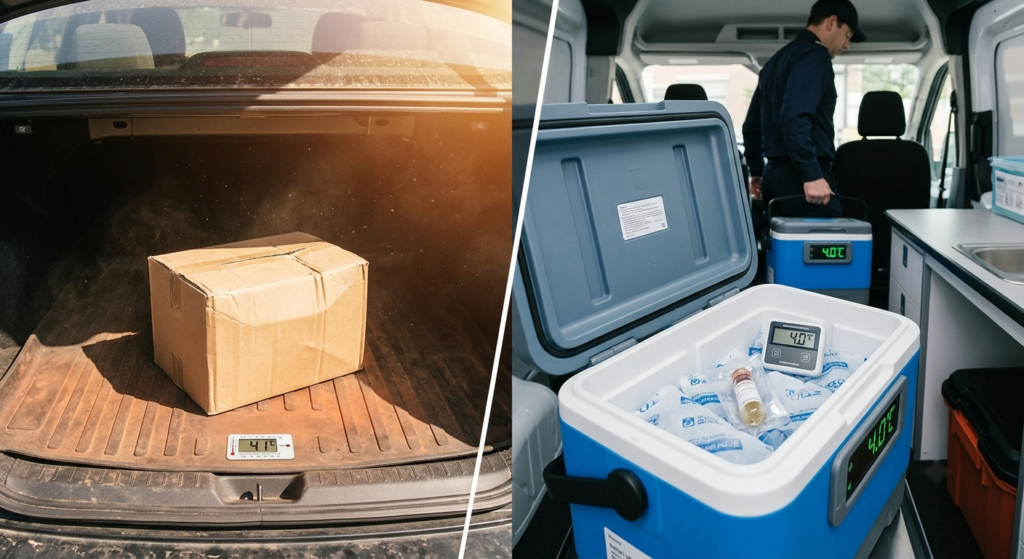
A regular courier picks up a package and delivers it. A medical courier picks up a blood specimen at 4°C and delivers it at 4°C with a signed chain of custody, a temperature log, and HIPAA-compliant documentation, all within a stability window that might be as short as two hours.
That is not the same job.
Power House Courier runs HIPAA-compliant, UN3373-certified specimen and medical deliveries 24/7 across California, Arizona and Texas. A dispatcher answers in under 15 minutes.
We get calls every week from lab managers whose previous courier was a regular same-day service. The story is almost always the same. The courier showed up in a personal vehicle with no insulated packaging. The specimen sat in the trunk. Nobody logged the temperature. Nobody signed a chain-of-custody form. The lab rejected the specimen because the sample was hemolyzed, clotted, or had no documentation the receiving lab could accept. The patient had to come back for a redraw. The physician’s office lost a day.
The courier company never knew any of this happened. They delivered the package. Job done. Except the package was a tube of human blood, and it was destroyed before it arrived.
Temperature is the difference between a result and a redraw
A regular courier treats every package the same. An envelope, a box of auto parts, a tube of blood. It goes in the vehicle, it gets delivered.
A medical courier knows that a CBC draw left at room temperature for more than four hours produces unreliable results. That a coagulation specimen in a citrate tube starts degrading within two hours. That a frozen biopsy sample that thaws for even ten minutes is useless for molecular testing.
The inside of a parked car in Los Angeles reaches 140°F within an hour on a summer afternoon. A regular courier who picks up three other packages before delivering your specimen just cooked it. They don’t have a temperature-controlled cooler. They don’t have calibrated gel packs. They don’t have a temperature logger. They have a car.
A medical courier in Los Angeles carries validated insulated coolers with calibrated gel packs that hold specimens at the required temperature for the entire transit. A temperature sensor inside the cooler logs a reading every 60 seconds. If the temperature drifts outside range, the dispatcher gets an alert. When the specimen arrives, the receiving lab gets a PDF showing the temperature was maintained from pickup to delivery.
That PDF is the difference between a specimen that produces a result and a specimen that gets thrown away.
HIPAA compliance is not optional
A regular courier has no obligation to protect health information. They’re not trained on HIPAA. They haven’t signed a Business Associate Agreement. They don’t know that a labeled blood tube is protected health information under federal law.
A medical courier operates as a HIPAA Business Associate. Every driver completes HIPAA training before their first medical run. They sign confidentiality agreements. They understand that specimen labels contain patient information and must be handled accordingly. The courier company maintains a signed Business Associate Agreement with every healthcare client.
If a regular courier loses a specimen or delivers it to the wrong address, and that specimen has a patient label on it, you have a HIPAA breach. That is a reportable event. The fines start at $100 per violation and go up to $50,000 per violation, with an annual maximum of $1.5 million per violation category.
A medical courier has the training, the documentation, and the operational procedures to prevent this. A regular courier doesn’t know the risk exists.
Chain of custody protects your organization
When a regular courier picks up a package, you get a tracking number. Maybe a delivery confirmation. That’s it.
When a medical courier picks up a specimen, the chain of custody starts at the moment of pickup. The driver verifies the specimen against the order. Photographs the packaging. Records the initial temperature. Captures a signed pickup receipt with a timestamp. GPS tracks the entire transit. Logs temperature continuously. At delivery, the recipient verifies and signs. The driver photographs the delivery point. A compiled record of every step, every temperature reading, every signature, and every timestamp goes into your inbox as a PDF within ten minutes.
If a regulatory auditor, an accreditation surveyor, or a plaintiff’s attorney asks what happened to a specific specimen on a specific date, you hand them the PDF. Everything is documented. If you used a regular courier, you have a tracking number that shows “delivered” and nothing else.
Packaging matters more than most people realize
A regular courier puts your package in the back seat or the trunk. Maybe a bag.
A medical courier transports diagnostic specimens in UN3373 Category B compliant packaging. This is a federal requirement for the transport of biological substances. The packaging has three layers: a primary receptacle (the specimen tube or container), a secondary container (a sealed, leak-proof bag or box), and an outer packaging (the transport cooler or shipping container). Each layer is designed to contain the specimen if the previous layer fails.
The driver carries a spill kit in the vehicle. If a specimen leaks, the driver knows how to contain it, decontaminate the area, and document the incident. A regular courier who finds a leaking tube of blood in the back seat has no idea what to do. And no obligation to handle it safely.
The cost comparison is misleading
A regular same-day courier in Los Angeles charges $30-60 for a local delivery. A medical courier charges more. Lab managers sometimes look at the price difference and choose the cheaper option.
Here is what the cheaper option actually costs:
The specimen is rejected at the lab. The patient comes back for a redraw. The phlebotomist’s time is wasted. The physician’s office loses the revenue from the visit. The patient is inconvenienced or, worse, has their diagnosis delayed. The lab misses the processing cutoff and the result comes back a day late. If the specimen was for a time-sensitive test, like a troponin for a suspected cardiac event or a blood culture for a septic patient, the delay has clinical consequences.
One rejected specimen costs more than the price difference between a medical courier and a regular courier. One HIPAA breach costs more than a year of medical courier service.
Our HIPAA-compliant courier checklist turns these differences into questions you can ask a vendor, and how medical courier pricing works explains where the price difference comes from.
When you need a medical courier vs a regular courier
Use a regular courier for documents, packages, auto parts, retail deliveries, and anything that doesn’t have temperature requirements, regulatory obligations, or patient information attached to it. Regular couriers are fine for regular packages.
Use a medical courier when the cargo is any of the following:
Blood specimens, tissue biopsies, urine samples, cultures, CSF, or any biological material that has a temperature requirement or a stability window.
Pharmaceuticals, especially biologics, compounded medications, or investigational product for clinical trials. Pharmaceutical courier service requires continuous temperature monitoring and FDA-compliant documentation.
Surgical instruments and implant kits that need to arrive sterile and on time for a scheduled procedure.
Medical records, imaging films, or any document that contains protected health information.
Organ or tissue for transplant. Cord blood collection kits.
Anything that, if lost, damaged, or exposed to the wrong temperature, creates a patient safety issue, a compliance violation, or a legal liability.
If you’re not sure which category your cargo falls into, call us at (323) 744-1900. We’ll tell you in 30 seconds whether you need a medical courier or a regular one. If it’s a regular package, we’ll still deliver it, but we won’t charge you for temperature monitoring you don’t need.
Power House Courier runs HIPAA-compliant, UN3373-certified specimen and medical deliveries 24/7 across California, Arizona and Texas. A dispatcher answers in under 15 minutes.
The bottom line
A regular courier moves packages. A medical courier protects specimens, maintains cold chain, documents chain of custody, and keeps your organization out of HIPAA trouble. They are different jobs requiring different training, different equipment, and different operational procedures.
If your current courier can’t produce a temperature log for the last specimen they delivered, or doesn’t have a signed Business Associate Agreement with your organization, or sends drivers who don’t have HIPAA training, you are using a regular courier for a medical courier job. And you are one rejected specimen or one HIPAA complaint away from a problem that costs more than the courier bill.
Power House Courier provides medical courier service across Los Angeles and statewide California. Call (323) 744-1900 or request a quote.

Critical logistics across the USA — same day courier, medical, legal, AoG, and nationwide trucking. Available 24/7.