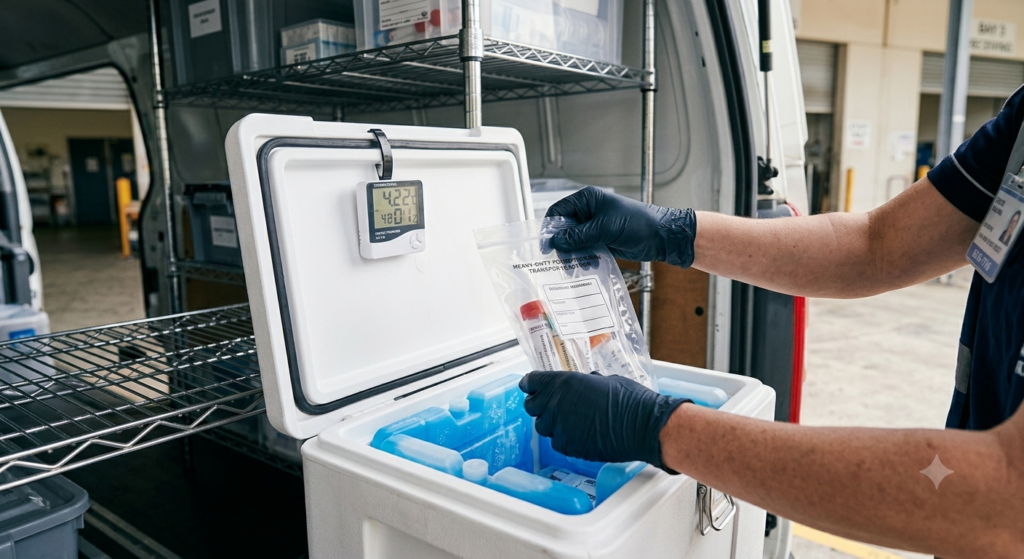
Most medical courier companies say they’re HIPAA compliant. It’s on their website, it’s in their pitch. But when your compliance officer asks for the actual documentation, the temperature logs, the pickup receipts, the delivery signatures, the audit trail, what do they actually hand over?
Power House Courier runs HIPAA-compliant, UN3373-certified specimen and medical deliveries 24/7 across California, Arizona and Texas. A dispatcher answers in under 15 minutes.
At Power House Courier, we’ve transported specimens, pharmaceuticals, and surgical materials for hospitals and labs across California, Arizona, and Texas since 2015. Over the past decade, we’ve refined our chain-of-custody process based on what compliance teams, accreditation auditors, and lab directors actually need, not what looks good on a brochure.
This post walks through exactly what our documentation process looks like, end to end. If you’re evaluating medical courier providers, this is the standard you should be asking them to meet.
What Chain of Custody Actually Means for Medical Couriers
Chain of custody in medical logistics is the documented, unbroken record of who handled a specimen or medical cargo, when they handled it, where it was at every point in transit, and what conditions it was stored under throughout.
Chain of custody is a system of interlocking records (dispatch logs, driver assignments, pickup receipts, GPS tracking data, temperature sensor readings, delivery signatures, and timestamped photos) that together prove the cargo was handled correctly from origin to destination.
For HIPAA-covered shipments, the chain of custody also documents that protected health information (PHI) associated with the cargo was safeguarded throughout. That means the specimen labels follow minimum-necessary principles, tracking systems use encrypted data transmission, and only credentialed personnel handle the cargo.
The reason this matters operationally: if any link in the chain is undocumented, the entire shipment’s integrity is questionable. A blood sample that arrived at the right temperature but without a documented pickup time? The lab can’t verify collection-to-processing time. A pharmaceutical shipment with a delivery signature but no temperature log? The pharmacist can’t confirm cold chain was maintained.
The 7-Point Documentation Trail We Generate on Every Medical Run
Every medical courier run at Power House Courier generates seven distinct documentation artifacts. Here’s what each one is and why it exists.
1. Dispatch Record
The moment a request comes in, by phone, email, or our dispatch portal, a timestamped record is created. This includes the requester’s identity, the pickup and delivery locations, the cargo description, any special handling requirements (temperature range, hazmat classification, urgency level), and the service level (STAT, Rush, or Standard).
The dispatch record also logs the driver assignment: which courier was selected, when they were notified, and when they acknowledged the assignment. Our average dispatch-to-driver-acknowledgment time is under 15 minutes for STAT requests.
2. Driver Credential Verification
Before a medical courier arrives at a hospital or lab, the system confirms that the assigned driver holds current credentials for that facility. Many hospitals, including Cedars-Sinai, UCLA Health, and Banner Health facilities in our service areas, require couriers to be pre-credentialed before they can enter specimen processing areas or pharmacy loading docks.
Credentialing typically includes a background check, TB test clearance, HIPAA awareness training verification, and a facility-specific orientation. We maintain a credential database for each driver so assignment can factor in which facilities they’re cleared for.
3. Pickup Receipt with Timestamp
At the collection point, the courier verifies the cargo against the manifest, confirming the number of containers, specimen types (if visible on outer packaging), packaging integrity, and any temperature indicators already present (such as chemical temperature strips on specimen transport bags).
A digital pickup receipt is generated with:
- Exact pickup time (GPS-synced, not driver-reported)
- Location coordinates (confirms the courier was physically at the collection site)
- Name and signature of the person who released the cargo
- Photo of the cargo at pickup (outer packaging only. no PHI visible)
- Temperature reading at the moment of pickup (for cold-chain shipments)
This receipt is the first hard timestamp in the chain. For lab specimens, the collection-to-receipt interval is often a critical quality metric. many assays have strict stability windows, and the pickup timestamp proves when the courier took possession.
4. Temperature Logging (Cold-Chain Shipments)
This is where most courier companies fall short. They’ll say “temperature controlled” but what they mean is “we put it in a cooler.” That’s packaging, not monitoring.
For cold-chain medical shipments, we use calibrated digital temperature loggers that record readings at configurable intervals, typically every 2 minutes for short runs, every 5 minutes for longer transports. The logger travels inside the insulated container with the cargo.
We maintain packaging protocols for three standard temperature ranges:
- Ambient (15–25°C): Room-temperature specimens, most surgical instruments, non-refrigerated pharmaceuticals. Insulated container with no active cooling, but monitored to confirm the cargo didn’t exceed range. particularly important in summer months in LA and Phoenix where vehicle interiors can exceed 50°C.
- Refrigerated (2–8°C): Most biological specimens, vaccines, insulin, many biologics. Validated insulated container with gel packs conditioned to 2–4°C. The most common temperature range we transport. roughly 60% of our medical cold-chain volume.
- Frozen (below −20°C): Certain tissue samples, some research specimens, specific pharmaceutical compounds. Dry ice packaging with validated hold times based on container size and ambient temperature.
The key word in all of this is “validated.” We don’t guess how long a gel pack will hold temperature. Our packaging configurations are tested. We know, for example, that our standard 2–8°C kit maintains range for approximately 8 hours at 35°C ambient, and approximately 12 hours at 25°C ambient. That validation data is available to clients on request.
5. In-Transit GPS Tracking
Every medical courier vehicle carries a GPS tracker that logs position continuously throughout the run. This serves two purposes: real-time visibility for the dispatch team and the client (we push ETA updates automatically), and a post-delivery record of the exact route taken.
The GPS log becomes relevant when a compliance team asks “where was the specimen between 2:15pm and 2:47pm?” We can answer that question with a coordinate-by-coordinate route map, not a driver’s recollection.
For sensitive shipments, the dispatch team monitors the route in real time and can intervene if the driver deviates, stops unexpectedly, or encounters a delay that might compromise the cargo.
6. Delivery Verification
At the destination, the delivery process mirrors the pickup:
- GPS-confirmed arrival at the delivery location
- Recipient name and digital signature
- Delivery timestamp (GPS-synced)
- Photo of the delivery point
- Final temperature reading (for cold-chain shipments)
- Temperature logger retrieved and data closed
The delivery signature is a named record: who specifically received the cargo, at what time, and at what location. For hospital deliveries, this is typically a lab technician, pharmacy staff member, or receiving dock coordinator whose name goes into the chain-of-custody record.
7. Post-Delivery Audit Package
Within minutes of delivery confirmation, the complete audit package is compiled and available to the client. This single document (or digital file) contains:
- Dispatch record with timestamps
- Driver credential status at time of assignment
- Pickup receipt with signature, time, location, and photo
- Complete temperature log graph (for cold-chain)
- GPS route map with timestamps
- Delivery receipt with signature, time, location, and photo
- Any exception notes (if a temperature excursion, delay, or deviation occurred)
This package is what your compliance team puts in the accreditation file. It’s what your QA department references when an auditor asks about specimen transport integrity. And it’s what protects your organization if a sample result is ever questioned. you can prove the chain was intact.
What a Temperature Excursion Looks Like (And What We Do About It)
No system is perfect. Temperature excursions happen. a cooler lid doesn’t seal properly, a gel pack wasn’t conditioned long enough, an unexpected traffic delay extends a run beyond the packaging’s validated hold time.
The difference between a professional medical courier and a generic delivery service is what happens when an excursion occurs.
Our temperature loggers have configurable alert thresholds. If the cargo temperature approaches the boundary of its required range. say, a refrigerated specimen reads 7.2°C when the acceptable range is 2–8°C. the system flags it. The dispatch team is alerted immediately, not after delivery.
When an excursion is detected in transit, the courier is contacted for an immediate assessment. Options include rerouting to the nearest facility, replacing compromised packaging materials, or. in worst-case scenarios. returning the specimen to the originating facility for recollection.
Critically, the excursion is documented. The temperature log shows exactly when the reading went out of range, how far out of range it went, and how long the excursion lasted. This documentation isn’t a liability. it’s a protection. The receiving lab can make an informed decision about whether the specimen is still viable, rather than processing a sample whose integrity is unknown.
HIPAA Compliance in Medical Courier Documentation
HIPAA applies to medical couriers as Business Associates when they transport cargo that contains or is associated with protected health information. In practice, this means most medical courier work. specimen transport, pharmaceutical delivery, medical records transfer, falls under HIPAA requirements.
Our HIPAA compliance isn’t a checkbox. It’s built into the documentation system:
- Minimum necessary PHI: Specimen labels and transport documentation contain only the minimum information needed for transport and chain of custody. We don’t need. and don’t want. patient diagnoses, full medical record numbers, or clinical notes.
- Encrypted transmission: All tracking data, signatures, photos, and temperature logs transmit over encrypted channels. The audit packages delivered to clients are transmitted securely.
- Access controls: Only the assigned courier, the dispatch team, and the client have access to shipment-specific data. There’s no shared dashboard where unrelated clients could see each other’s shipments.
- Business Associate Agreements: We execute BAAs with all healthcare clients. The agreement specifies our obligations as a Business Associate, including breach notification procedures, permitted uses of PHI, and safeguard requirements.
- Incident response: If a HIPAA-relevant incident occurs. a lost shipment, a misdirected delivery, a documentation error that exposes PHI. we have a documented response protocol that includes containment, assessment, notification, and corrective action.
What to Ask Your Medical Courier Provider
If you’re evaluating medical courier companies, here are the questions that separate the professionals from the generalists:
- Can you show me a sample audit package from a completed delivery? If they can’t produce one on the spot, their documentation isn’t systematic.
- What temperature ranges do you support, and what are the validated hold times for your packaging? “We use coolers” isn’t an answer. You need specific ranges and tested durations.
- How quickly can you provide the temperature log after delivery? If the answer is “a few days” or “on request,” the logging isn’t real-time. Our logs are available within minutes.
- What happens when a temperature excursion occurs in transit? If they don’t have a documented protocol, they haven’t thought about it. which means they probably won’t handle it well.
- Are your drivers credentialed at our facility? If they have to “look into it,” their credentialing system isn’t organized enough for medical work.
- Can you execute a Business Associate Agreement? If they hesitate, they may not understand their HIPAA obligations as a medical courier.
Power House Courier runs HIPAA-compliant, UN3373-certified specimen and medical deliveries 24/7 across California, Arizona and Texas. A dispatcher answers in under 15 minutes.
The Bottom Line
Chain of custody for medical couriers isn’t about paperwork for the sake of paperwork. It’s a system that protects specimen integrity, ensures regulatory compliance, and gives your organization defensible documentation when it matters.
Every medical courier run at Power House Courier generates a complete, timestamped, temperature-documented audit trail. from the moment the dispatch call comes in to the moment the delivery signature is captured. That documentation is available to your team within minutes, not days.
If your current courier can’t match that standard, your specimens deserve better.
Power House Courier provides HIPAA-compliant medical and biomedical courier service across Los Angeles, Phoenix, Houston, and 11 cities nationwide. 24/7 dispatch at (323) 744-1900 or request a quote online.

Critical logistics across the USA — same day courier, medical, legal, AoG, and nationwide trucking. Available 24/7.