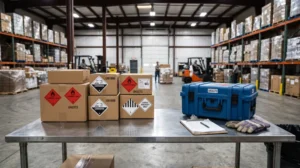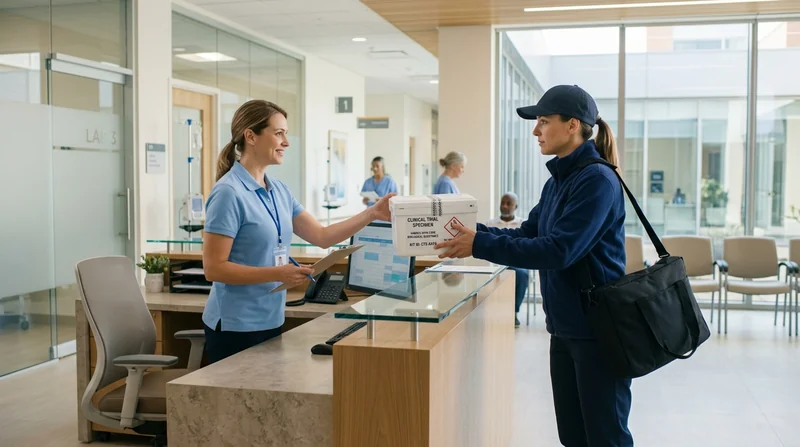
A clinical trial courier moves the physical pieces of a study between the people running it: collection kits to sites, investigational product to pharmacies and patients, and specimens from sites to central labs, usually against a fixed temperature range and a hard deadline. The job looks like ordinary same-day delivery until you add protocol windows, dry ice, weekend visits and the paperwork that has to survive an inspection.
This guide is for study coordinators, CRAs, site managers and clinical supply teams working in Southern California, including Los Angeles and San Diego. It covers each shipment type, the temperature bands involved, what GCP expects from the records, and how to plan for visits that fall on a Saturday.
TL;DR
Power House Courier runs HIPAA-compliant, UN3373-certified specimen and medical deliveries 24/7 across California, Arizona and Texas. A dispatcher answers in under 15 minutes.
- Clinical trial courier work usually falls into four flows: kits to sites, investigational product (IP) to sites or patients, specimens to central labs, and returns of unused product.
- ICH E6(R3), adopted by ICH in January 2025 and published by FDA as final guidance in September 2025, lists shipping records and IP storage conditions during shipment as essential trial records.
- Diagnostic specimens usually ship as UN3373 Biological Substance, Category B, in triple packaging that must pass a 1.2 meter drop test under 49 CFR 173.199.
- Dry ice sits at about -78.5°C, and packages using it must vent carbon dioxide gas and be marked as dry ice.
- FDA’s 2024 decentralized trials guidance lets sponsors ship IP directly to participants, but the investigator must still authorize release and confirm receipt.
What a clinical trial courier moves
Most study logistics fit into four flows. Collection kits and supplies go from a central lab or depot to the site before a visit. Investigational product goes from a depot or pharmacy to the site, or in some trials straight to a participant’s home. Specimens drawn at the visit go from the site to a central or specialty lab. Unused or expired product comes back for accountability and destruction.
Each flow has its own risk. A kit that arrives late means a visit gets rescheduled, and in a trial with tight visit windows that can become a protocol deviation. A specimen that sits past a lab’s receipt cutoff may be unusable. IP that drifts out of range may have to be quarantined until the sponsor decides whether it can still be used.
That’s why a courier on trial work needs to understand the calendar as well as the route. The pickup time is set by the draw time, the processing steps at the site and the lab’s receiving hours, and all of them come from the protocol and the lab manual.
Shipment types and what each one needs
The table below is a starting point. Your protocol, pharmacy manual and lab manual always override it.
| Shipment | Typical temperature | Packaging and marking | Records to keep |
|---|---|---|---|
| Collection kits to site | Usually ambient; check kit label | Standard box; check kit expiry on receipt | Kit IDs, receipt date, expiry |
| IP, refrigerated | Per label, often 2-8°C | Qualified shipper with data logger | Shipping record, logger file, receipt confirmation |
| IP, frozen or ultra-cold | Per label; dry ice or specialty shipper | Dry ice marking and net weight; vented package | Same as above, plus dry ice quantity |
| Specimens to central lab | Ambient, refrigerated or frozen per lab manual | UN3373 triple packaging | Requisition, chain of custody, lab receipt |
| Direct-to-patient IP | Per label | Shipper plus patient instructions | Investigator release, proof of receipt |
| Returns and destruction | Per sponsor instructions | As packed by the site pharmacy | Accountability log, return form |
Investigational product and temperature ranges
The sponsor decides how IP must be stored and moved. ICH E6(R3) section 3.15.2 says the sponsor should determine acceptable storage temperatures and conditions, and that IP should be packaged to prevent contamination and unacceptable deterioration during transport and storage. The courier’s job is to keep the product inside the range the sponsor set and to prove it afterward.
Refrigerated product is the most common case. For comparison, CDC’s vaccine storage guidance sets refrigerators at 2°C to 8°C and freezers at -50°C to -15°C, and many study drugs carry similar labels. Your IP label is the one that counts.
Frozen and ultra-cold product usually moves on dry ice or in a specialty shipper. Cornell University’s dry ice tip sheet puts dry ice at about -78.5°C. Under 49 CFR 173.217, packaging must let carbon dioxide gas escape so pressure can’t build up and rupture it, and by air the net mass of dry ice must be marked on the outside. Dry ice also sublimates in transit, so a shipper packed for a four-hour run may not hold if the delivery slips to the next morning.
For all temperature-controlled IP, the courier should know three things before pickup: the allowed range, the logger in the box and when it was started, and what to do if the delivery can’t be completed. The last one matters most. “Hold it in the van overnight” is almost never the right answer.
Site-to-central-lab specimen shipments
Specimens are where courier timing most directly affects data. The lab manual sets processing steps, the temperature for each tube type and the latest time the lab will accept a sample.
Most clinical trial specimens ship as UN3373, Biological Substance, Category B. Under 49 CFR 173.199, that means triple packaging: a leakproof primary receptacle, leakproof secondary packaging with absorbent material, and a rigid outer package that can survive a 1.2 meter drop. The outer package carries the UN3373 diamond and the proper shipping name. By air, liquid specimens are limited to 1 liter per primary receptacle and 4 liters per outer package. Dry ice may be placed outside the secondary packaging.
Local couriers usually handle the first leg: site to central lab if the lab is in the region, or site to an airline or express carrier hub if it isn’t. In Los Angeles and San Diego, a same-day ground run to a regional lab can be faster than any overnight option, and it keeps one person accountable for the box the whole way.
Ask the site to tell the courier the draw time, the number of boxes and the temperature state of each one when booking. A mixed pickup (one ambient box, one frozen) is common, and it changes what the driver brings.
Direct-to-patient deliveries in decentralized trials
More trials now send product or home collection kits straight to participants. FDA’s final guidance, Conducting Clinical Trials With Decentralized Elements (September 2024), allows this but keeps the investigator in charge. When IP is distributed directly to participants, the guidance says the investigator must authorize release by the distributor and confirm receipt. Sponsors should document how IP integrity and stability, including temperature control, will be maintained in transit. The guidance also notes that drugs with good stability profiles suit direct shipment best, while those needing special handling may not.
For the courier, a home delivery is part logistics, part privacy. The driver may be the only study contact the participant sees that day. Good practice is simple: confirm the delivery window with the participant or site ahead of time, never leave IP unattended, capture a signature or other proof of receipt that meets the protocol, and keep the participant’s details off anything visible on the package beyond what’s needed to deliver it.
Documentation, GCP and temperature excursions
GCP cares about courier records because they’re part of the trial record. The ICH E6(R3) guideline, adopted by ICH on 6 January 2025, lists as essential records the shipping records for IP and trial materials, documentation of IP storage conditions including during shipment, and documentation of collection, processing and shipment of specimens. It also asks the sponsor to keep records of the identity, shipment, receipt and return of IP. ACRP reports that FDA published E6(R3) as final guidance on 9 September 2025.
In practice, that means the courier’s proof of pickup, time stamps, chain of custody and logger data may end up in the trial master file. Ask for those records in a format your team can file without retyping.
Electronic records raise one more question. FDA’s Part 11 scope and application guidance explains that 21 CFR Part 11 applies to electronic records kept under FDA recordkeeping requirements, and that FDA interprets its scope narrowly. Whether a given courier portal or logger platform falls under Part 11 is a call for your sponsor’s quality team. What a courier can do is give you exportable, time-stamped records that don’t change after the fact.
When the temperature goes out of range
An excursion is any reading outside the labeled range. The sponsor decides whether the product can still be used. CDC’s process for vaccines is a useful model: label the product “do not use,” keep it apart from good stock, notify the responsible person, document what happened and contact the manufacturer for guidance. For IP, the site quarantines the product and sends the logger data to the sponsor or CRO. The courier’s role is to report fast with a clear timeline and hand over the logger file without being chased.
Weekend visits and coordinating with CRAs and labs
Many trials schedule visits on a fixed day count from dosing, and the calendar doesn’t care that day 14 is a Sunday. Central labs may or may not receive on weekends, so check before booking the visit. If the lab is closed, the lab manual will say whether the specimen can be held, and at what temperature.
A few steps help when a visit falls outside business hours:
- Book the courier when the visit is scheduled, not on the morning of it.
- Give the courier the site’s after-hours entrance and a coordinator’s mobile number.
- Confirm the lab’s weekend receiving address, which is sometimes different from the weekday dock.
- Tell the CRA which shipments went out, so reconciliation doesn’t wait until Monday.
When choosing a courier for study work, ask whether dispatch answers around the clock, how drivers are trained on UN3373 and dry ice, what temperature monitoring they can supply, and how records are delivered after each run. Our clinical trials page covers how we approach this work, and our temperature-controlled courier and bio-medical courier pages describe the handling side. Sites south of Orange County can start with our San Diego courier page.
Related guides: for packaging and labeling of site-to-lab specimens, see how biological samples are shipped. Trials that ship by air should review the 2027 dangerous goods updates, and studies handling blood products can compare notes with our blood courier guide.
Frequently asked questions
What does a clinical trial courier do?
A clinical trial courier moves study materials between depots, sites, labs and sometimes participants’ homes. That includes collection kits, investigational product, specimens and returns. The courier keeps the shipment within the temperature range set by the protocol, meets lab cutoffs and hands over records such as pickup times, chain of custody and logger data.
Can a courier ship investigational product directly to a patient?
Yes, when the protocol allows it. FDA’s 2024 guidance on decentralized elements permits direct distribution, but the investigator must authorize release and confirm receipt, and the sponsor must document how the product stays stable in transit. The courier follows the delivery and proof-of-receipt steps the sponsor sets out.
How are clinical trial blood samples packaged for transport?
Most ship as UN3373 Biological Substance, Category B, in triple packaging: a leakproof primary tube, leakproof secondary packaging with absorbent material, and a rigid outer box. The outer box carries the UN3373 mark. Frozen samples usually travel on dry ice, which must be vented and marked. Follow your lab manual for tube-specific rules.
What happens if a shipment has a temperature excursion?
The receiving site should quarantine the product and send the logger data to the sponsor or CRO, who decides whether it can still be used. The courier should report the problem right away, explain the timeline and provide the full logger file. Never use product from an excursion until the sponsor clears it.
Do couriers handle weekend and holiday study visits?
Many do. The harder constraint is usually the lab’s receiving schedule. Check the central lab’s weekend receiving hours and address before booking the visit. If the lab is closed, the lab manual will say whether and how the specimen can be held until it reopens.
What records should I get from a clinical trial courier?
At minimum: pickup and delivery times, the names of who handed over and who received, the chain of custody and, for temperature-controlled shipments, the logger data. ICH E6(R3) treats shipping records and shipment storage conditions as essential records, so ask for formats your team can file directly.
Power House Courier runs HIPAA-compliant, UN3373-certified specimen and medical deliveries 24/7 across California, Arizona and Texas. A dispatcher answers in under 15 minutes.
Sources
- ICH E6(R3) Guideline for Good Clinical Practice, Step 4, adopted 6 January 2025
- ACRP: FDA Publishes ICH E6(R3): What it Means for U.S. Clinical Trials
- FDA: Conducting Clinical Trials With Decentralized Elements, final guidance (September 2024)
- FDA: Part 11, Electronic Records; Electronic Signatures, Scope and Application
- 49 CFR 173.199, Category B infectious substances (Cornell LII)
- 49 CFR 173.217, Carbon dioxide, solid (dry ice) (Cornell LII)
- CDC Pink Book, Chapter 5: Vaccine Storage and Handling
- Cornell University EHS: Dry Ice Tip Sheet
Planning a study visit or a lab run? Call dispatch at (323) 744-1900 or request a quote.
Last reviewed: September 2026 by the Power House Courier dispatch team.

Critical logistics across the USA — same day courier, medical, legal, AoG, and nationwide trucking. Available 24/7.