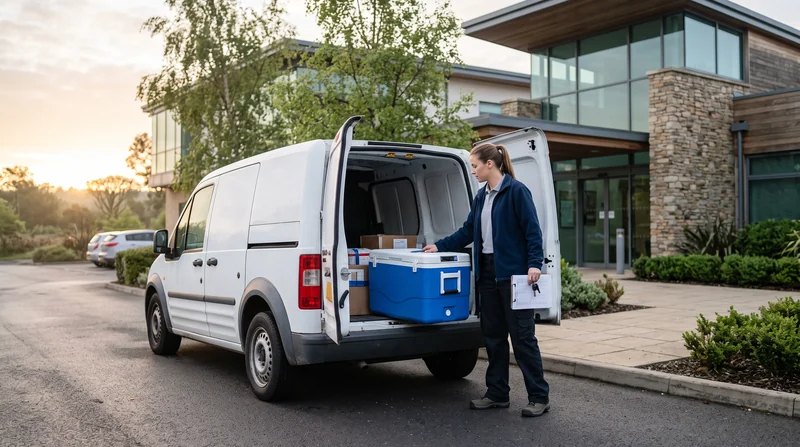
If you’re figuring out how to become a medical courier, the short version is this: you need a valid driver’s license, a clean driving record, a dependable vehicle with insurance, and the ability to pass a background check, and then you need training in specimen handling and patient privacy. Most people come in through a courier company, either as an employee or as an independent contractor, and learn the routes from there.
The work itself is steady and sometimes urgent. You’ll carry lab specimens, medications, records and supplies between clinics, hospitals and labs, often on fixed routes with the occasional STAT call that has to move right now.
This guide covers the usual requirements, the training that matters, how worker classification works in California, what published pay data does and doesn’t tell you, and what a normal day looks like. We’ve kept it neutral. Requirements and pay vary by company, and nothing here is a promise of work or earnings.
Power House Courier runs HIPAA-compliant, UN3373-certified specimen and medical deliveries 24/7 across California, Arizona and Texas. A dispatcher answers in under 15 minutes.
TL;DR
- Courier companies typically ask medical drivers for a valid license, a clean driving record, insurance, a reliable vehicle and a background check, and some add a drug screen.
- Expect HIPAA awareness training, plus OSHA bloodborne pathogens training where your duties bring reasonably anticipated exposure, which OSHA requires at assignment and at least annually.
- Anyone who transports UN3373 Category B specimens under 49 CFR 173.199 “must know about the requirements” of that section.
- In California, the ABC test presumes a worker is an employee unless the hiring entity proves all three parts, and a 1099 label alone doesn’t decide it.
- BLS reported a May 2025 median hourly wage of $18.85 for couriers and messengers nationally, a figure that excludes self-employed contractors.
What a medical courier does
A medical courier moves time- or temperature-sensitive healthcare items from one place to another and keeps a record of every handoff. That sounds like any delivery job. The difference is in what’s in the box.
A blood sample that sits in a hot car can become unusable, and a patient may need a second draw. A records box left unattended can turn into a privacy incident for the clinic. So the job rewards people who are careful and on time, more than people who are fast. Our page on the difference between a medical courier and a regular courier goes into this from the client’s side.
Typical loads include lab specimens (blood, urine, tissue), pharmacy orders, medical records, equipment and supplies. Some drivers also handle bio-medical shipments such as clinical trial kits, or cold chain items that need dry ice or gel packs.
How to become a medical courier: the basic requirements
There’s no federal license called “medical courier.” Requirements come from the courier company, its clients and its insurer, so they vary. Common requirements look like this:
- A valid driver’s license, and often a minimum age and years of driving experience.
- A motor vehicle record (MVR) without recent major violations.
- Auto insurance that meets the company’s requirements, which for contractors may mean commercial or business-use coverage.
- A reliable, clean vehicle with working air conditioning, since cabin heat matters for specimens.
- A background check, and at some companies a drug screen, especially for hospital accounts.
- A smartphone that can run the company’s dispatch or proof-of-delivery app.
Hospitals may also run their own vendor credentialing, which can mean extra paperwork, a badge, or proof of vaccinations before you’re allowed into certain areas. Ask about this early. It can add days to your start date.
If you found this by searching for “medical courier apps,” know that medical routes rarely work like same-day food delivery signups, because clients want to know who’s carrying their specimens. Expect an application, screening and some training before your first run.
Training you should expect
Good medical courier companies train before they dispatch. Three areas come up again and again.
Patient privacy (HIPAA awareness)
You’ll likely handle items with patient information on them. HHS describes couriers that only transport PHI, with no more than random or infrequent access, as “conduits” rather than business associates. Your company’s clients will still expect you not to read, photograph, discuss or leave unattended anything with patient details. HIPAA awareness training covers what counts as PHI and what to do if something goes missing.
Bloodborne pathogens
OSHA’s standard at 29 CFR 1910.1030 applies to “reasonably anticipated” occupational exposure to blood or other potentially infectious materials. Where it applies, the employer must provide training at initial assignment and at least annually after that, and must make hepatitis B vaccination available within 10 working days of initial assignment. Whether it applies to a given courier role depends on the duties. If you’re an independent contractor, ask what training the company provides or expects you to have.
Specimen transport rules (UN3373)
Many diagnostic specimens travel as “Biological substance, Category B,” marked UN3373. For road transport, 49 CFR 173.199 requires triple packaging and says each person who offers or transports these packages “must know about the requirements of this section.” In practice, the lab packs the specimen and you need to recognize a correct package, keep it upright and secure, and know what to do if it leaks. Drivers who handle air shipments or dry ice may need more formal dangerous goods training.
Independent contractor or employee in California
Searches for “independent medical courier” and “medical courier independent contractor” are common, and in California the answer depends on the law, not just the contract you sign.
California uses the ABC test. According to the Labor and Workforce Development Agency, a worker is an employee unless the hiring entity shows all three of these:
- The worker is free from the hiring entity’s control and direction in performing the work, under the contract and in fact.
- The work is outside the usual course of the hiring entity’s business.
- The worker is customarily engaged in an independently established trade, occupation or business of the same nature.
The Labor Commissioner’s FAQ adds that the hiring entity “cannot unilaterally determine a worker’s status” by calling someone an independent contractor, and that labels, written agreements and 1099 forms don’t settle the question. The same FAQ notes that some occupations fall under exemptions using the older Borello test, and that app-based drivers can be contractors under Proposition 22 if specific conditions are met.
We’re not going to tell you which arrangement is right for you, and we can’t give legal advice. If you’re offered contractor work, it’s reasonable to ask the company how it has assessed the classification, and to check with the Labor Commissioner’s office or a professional if you’re unsure. The practical differences matter: employees generally have taxes withheld by the employer, while contractors usually handle their own taxes, insurance and vehicle costs.
What published pay data shows
We only cite published government data here, and even that has limits.
The Bureau of Labor Statistics publishes wages for the occupation “couriers and messengers” through its Occupational Employment and Wage Statistics (OEWS) survey. The latest national figures, from May 2025, look like this:
| Measure (May 2025, national) | Couriers and messengers | All occupations |
|---|---|---|
| Employment | 68,640 | 155,495,730 |
| Median hourly wage | $18.85 | $24.51 |
| Mean hourly wage | $19.70 | $33.54 |
| Mean annual wage | $40,970 | $69,770 |
Two cautions. First, this category covers all couriers and messengers, not just medical ones. Second, BLS says the OEWS survey covers wage and salary workers and “does not include the self-employed”, so independent contractors aren’t in these numbers at all. Contractor income depends on route volume, mileage, fuel, insurance and vehicle wear, and we won’t guess at it. Ask any company you talk to how pay is calculated and what costs are yours.
A day on a medical route
No two companies run the same schedule, but most medical courier work falls into a few patterns.
Scheduled routes are the backbone. A driver might start early with a loop of clinics, collecting specimens that were drawn overnight or first thing, then deliver them to a lab before a processing cutoff. Afternoon routes often repeat the loop. You’ll scan or sign at every stop so the chain of custody is complete.
STAT calls interrupt that rhythm. A hospital needs a specimen, a unit of product or a piece of equipment moved immediately, and dispatch sends whoever is closest. These runs are why companies care about response times and why a driver who answers the phone and knows the area is valuable. See our medical courier page for how these services are set up on the client side.
Cold chain work adds steps. You may pick up coolers with gel packs or dry ice, check that a temperature logger is running, and keep the package out of direct sun. Some items need to be delivered within a set window.
Then there’s the less glamorous part: traffic, parking at hospitals, waiting at a lab window, and long stretches of driving. People who like predictable routines and can stay calm when the phone rings at 2 a.m. tend to do well.
Equipment you’ll use
Companies usually supply or specify specimen transport coolers, spill kits, gloves and hand sanitizer, and sometimes temperature loggers. You bring the vehicle, a phone and, often, an insulated cargo area or at least a clean, secure space to keep boxes upright. Ask what’s provided and what you’re expected to buy.
Applying to drive medical routes
When you talk to a courier company, ask direct questions. Is the role employee or contractor, and why? What training happens before the first run? Who pays for insurance, fuel and supplies? Are routes scheduled, on call, or both? How are STAT calls assigned?
If you’re in Southern California or the other areas we serve and want to drive with us, start on our driver onboarding page. That’s where applications start. Our service pages show how our medical courier and bio-medical courier services work, which gives you a sense of the runs involved.
Related guides: the HIPAA-compliant courier checklist shows what employers and clients expect from a medical courier, our guide to biological sample transport covers the packaging you will handle daily, and the flu season pickup plan shows what the busiest months look like.
Frequently asked questions
Do you need a special license to be a medical courier?
There’s no federal license specifically for medical couriers. You need a valid driver’s license for the vehicle you drive, and courier companies set their own requirements for driving record, insurance and background checks. Drivers who handle air shipments or larger quantities of dangerous goods may need formal hazmat training, which the company should explain before you take those runs.
Can I be an independent medical courier in California?
Some couriers work as independent contractors, but in California the ABC test presumes a worker is an employee unless the hiring entity proves all three parts. Calling you a contractor or issuing a 1099 doesn’t decide it. Ask the company how it classified the role, and contact the Labor Commissioner’s office or a professional if you have questions.
How much do medical couriers make?
BLS doesn’t publish a separate figure for medical couriers. For all couriers and messengers, the national median hourly wage was $18.85 in May 2025. That data covers employees only and excludes the self-employed, so it says nothing about contractor earnings, which depend on volume and the costs you carry.
Do medical couriers need HIPAA training?
Expect HIPAA awareness training from a medical courier company, because drivers handle items with patient information. HHS treats couriers with only transient access as conduits rather than business associates, but clients still expect drivers to keep patient details private and report any lost item immediately. The company’s own policies will set the specifics.
Is a medical courier job stressful?
It can be, mainly around STAT calls, lab cutoffs and traffic. Scheduled routes tend to be predictable, and many drivers like that. The pressure comes from knowing a delay can affect a patient’s test, so the job suits people who plan ahead, communicate with dispatch and stay calm when plans change mid-shift.
Do I need my own vehicle?
Usually yes, especially for contractor roles. Companies generally want a reliable, clean car, SUV or van with working air conditioning and room to keep coolers upright. Some larger shipments call for cargo vans. Ask whether the company has vehicle age or size requirements and who covers fuel, maintenance and insurance.
Power House Courier runs HIPAA-compliant, UN3373-certified specimen and medical deliveries 24/7 across California, Arizona and Texas. A dispatcher answers in under 15 minutes.
Sources
- U.S. Bureau of Labor Statistics, Table 1. National employment and wage data by occupation, May 2025
- U.S. Bureau of Labor Statistics, Occupational Employment and Wage Statistics Overview
- California Labor and Workforce Development Agency, ABC Test
- California Labor Commissioner’s Office (DIR), Independent Contractor versus Employee FAQ
- 29 CFR 1910.1030, Bloodborne pathogens (Cornell LII)
- 49 CFR 173.199, Category B infectious substances (Cornell LII)
- HHS, Are the following entities considered business associates: US Postal Service, UPS, delivery truck line employees?
To drive medical routes with us, start on our driver onboarding page, or call (323) 744-1900 with questions.
Last reviewed: September 2026 by the Power House Courier dispatch team.

Critical logistics across the USA — same day courier, medical, legal, AoG, and nationwide trucking. Available 24/7.