TL;DR
Lab courier companies transport blood specimens, urine samples, tissue biopsies, and other biological materials between collection sites and testing laboratories under strict temperature and time constraints. Choosing the wrong courier means rejected specimens, repeated blood draws, and delayed diagnoses. This guide compares 6 lab courier providers, explains specimen transport requirements by type, and includes a 7-point evaluation checklist for selecting a provider.
Power House Courier runs HIPAA-compliant, UN3373-certified specimen and medical deliveries 24/7 across California, Arizona and Texas. A dispatcher answers in under 15 minutes.
Table of Contents
- What lab courier companies do
- Lab courier companies in the United States
- Comparison at a glance
- Specimen types and transport requirements
- How to evaluate a lab courier
- Cost factors in lab courier service
- Getting started
A rejected specimen costs more than the courier fee. It costs the patient a second blood draw, the clinician a delayed diagnosis, and the lab wasted reagents and technician time. When a hospital emergency department sends a STAT blood culture to an off-site reference lab, the courier who carries that tube is the weakest link in the diagnostic chain or the strongest. There is no middle ground.
Lab courier companies exist because FedEx and UPS were not built for this. Standard parcel carriers sort packages through distribution hubs, expose them to ambient dock temperatures, and deliver on their own schedule. A blood specimen collected in a lavender-top EDTA tube has a stability window measured in hours, not days. A urine culture left at room temperature for too long will grow contaminants that produce a false positive. A frozen tissue biopsy that thaws in transit is destroyed.
This guide covers what lab couriers actually do, how they differ from general delivery services, and which companies serve clinical laboratories across the United States.
What Lab Courier Companies Do
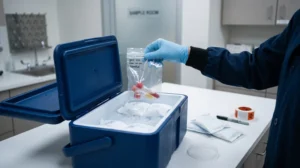
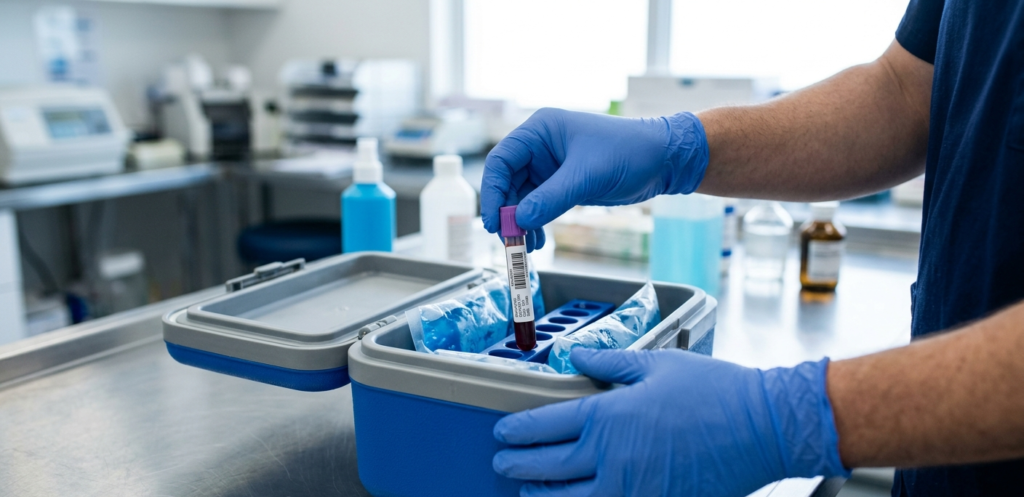
A lab courier company provides scheduled and on-demand transport of biological specimens between collection sites and testing laboratories. The typical workflow looks like this: a phlebotomist or nurse collects a specimen at a hospital, clinic, physician office, or patient service center. The specimen is packaged according to DOT and IATA regulations (UN3373 for Category B biological substances), placed in a temperature-appropriate container, and handed to the courier with a chain-of-custody manifest. The courier transports it to the destination lab, maintains temperature integrity during transit, and delivers it with a documented handoff including timestamp, signature, and condition verification.
That sounds simple. It is not. The complexity comes from three overlapping requirements that general couriers do not handle well.
Temperature control across multiple ranges. Different specimen types require different temperatures. Whole blood for CBC testing needs room temperature (18-25°C). Serum for chemistry panels needs refrigeration (2-8°C). Frozen specimens for molecular testing need dry ice (-20°C or colder). A single route pickup from a multi-specialty clinic might include all three. The courier’s vehicle and packaging system must maintain separate temperature zones simultaneously, with calibrated sensors logging conditions throughout transit.
Time sensitivity with hard cutoffs. Specimen stability windows vary by test type. A basic metabolic panel on serum is stable for about 4 hours at room temperature. A coagulation study on citrated plasma has a 1-hour processing window in many labs. Blood gases collected in heparinized syringes degrade within 30 minutes at room temperature. The courier’s route and schedule must account for these windows, and STAT specimens must be prioritized over routine pickups without disrupting the rest of the route.
Regulatory compliance at every step. HIPAA governs the protected health information on specimen labels and requisitions. OSHA bloodborne pathogen standards (29 CFR 1910.1030) require couriers to have exposure control plans, PPE, and training. DOT hazardous materials regulations mandate UN3373 packaging for Category B biological substances. CAP (College of American Pathologists) and CLIA accreditation standards require labs to document that their courier processes preserve specimen integrity. A courier that cannot produce documentation proving compliance with all of these is a liability for any lab that uses them.
Lab Courier Companies in the United States
Power House Courier
Power House Courier operates from Los Angeles with offices in Tempe, AZ and Spring, TX. Their lab courier service covers STAT and scheduled specimen transport for hospitals, reference labs, clinical labs, and physician office networks across California, Arizona, Texas, and nationwide via air courier.
PHC provides temperature-controlled transport across ambient, refrigerated, and frozen ranges with calibrated sensor logging. All drivers are HIPAA-trained, UN3373-certified for biological specimen packaging, and credentialed at major hospital systems including Cedars-Sinai, UCLA Medical Center, Banner Health, and Mayo Clinic (Arizona). Chain of custody is documented digitally with timestamps, signatures, and photo proof at pickup and delivery.
PHC handles both scheduled daily route pickups (morning and afternoon collection cycles) and on-demand STAT transport with a 15-minute dispatcher response and 24/7 availability. They also provide next-flight-out service from LAX, PHX, and IAH for specimens that need to reach distant reference labs the same day.
Phone: (323) 744-1900. Website: phclax.com
carGO Health
carGO Health is a medical courier built specifically for clinical and diagnostic laboratories. They provide STAT and scheduled specimen transport with real-time GPS tracking, temperature monitoring, and digital chain-of-custody. Their platform integrates with laboratory information management systems (LIMS) for automated order creation and delivery confirmation. They serve reference labs including Pathline Labs and Inform Diagnostics and report a 100% client retention rate.
Coverage: Major U.S. metro areas. Focused on laboratory clients rather than general medical delivery.
Life Couriers (formerly Associated Couriers)
Life Couriers has operated since 1977 and holds GDP certification for pharmaceutical and specimen logistics. They provide dedicated daily routes and same-day delivery for biological samples, medical supplies, and pharmaceutical products. All drivers are drug-screened, background-checked, and hold Hazmat-endorsed CDL licenses. They serve hospitals, pharmacies, medical clinics, and laboratories nationwide.
Coverage: Nationwide, with established route networks in major metro areas.
The Lab Courier
The Lab Courier is a specialized medical courier focused on healthcare logistics and specimen transportation. Their leadership team has over 20 years of experience in healthcare logistics and last-mile delivery. They transport blood work, urine samples, prescription drugs, biopsies, and infectious materials using UN3373-certified packaging and temperature-controlled containers.
Coverage: Regional. Check availability for your metro area.
World Courier (AmerisourceBergen)
World Courier is a global clinical trial logistics provider owned by AmerisourceBergen. They specialize in temperature-controlled transport for clinical trial specimens, investigational drugs, kits, reagents, and medical devices. Their cold chain management covers ambient through cryogenic temperatures with validated packaging and continuous monitoring. Strong fit for pharmaceutical sponsors and CROs running multi-site clinical trials that need specimen logistics across international borders.
Coverage: Global. Best suited for clinical trial logistics rather than routine daily lab pickups.
National Delivery Solutions
National Delivery Solutions provides medical and lab courier services across the United States. They handle specimen transport, medical records, oxygen tanks, medical equipment, and lab deliveries for healthcare facilities, medical providers, and laboratories with time-critical delivery requirements.
Coverage: National.
Comparison at a Glance
| Company | Focus | Coverage | 24/7 STAT | Best For |
|---|---|---|---|---|
| Power House Courier | STAT + scheduled lab transport | CA, AZ, TX, nationwide air | Yes | Hospitals and labs needing both STAT and routed service |
| carGO Health | Lab-specific, LIMS integration | Major metros | Yes | Reference labs wanting tech-forward integration |
| Life Couriers | Healthcare logistics, GDP certified | Nationwide | Yes | Large health systems with daily route volume |
| The Lab Courier | Specimen transport specialist | Regional | Varies | Labs wanting personalized, hands-on service |
| World Courier | Clinical trial logistics | Global | Yes | Pharma/CRO clinical trial specimens |
| National Delivery Solutions | General medical courier | National | Yes | Multi-facility health systems |
Specimen Types and Transport Requirements
Not all specimens travel the same way. A lab courier that treats every tube the same will eventually deliver a compromised sample. Here are the categories that matter most and their transport constraints.
Whole blood (EDTA, heparin tubes). Room temperature transport (18-25°C). Do not refrigerate or freeze. CBC samples are stable for approximately 24 hours at room temperature, but many labs prefer receipt within 4-6 hours for optimal results. Avoid extreme heat, which causes hemolysis, the single most common reason for specimen rejection in clinical labs.
Serum and plasma (gel separator, citrate tubes). Centrifuge before transport when possible. Serum is stable refrigerated for up to 48 hours for most chemistry panels. Citrated plasma for coagulation studies has a much tighter window and some assays require processing within 1 hour of collection. Transport refrigerated (2-8°C) unless the lab specifies otherwise.
Urine specimens. Refrigerate after collection. Urine cultures left at room temperature for more than 2 hours will show bacterial overgrowth that produces inaccurate results. Transport at 2-8°C. Preservative tubes (boric acid) extend stability but do not eliminate the need for timely delivery.
Microbiology cultures. Room temperature for most bacterial cultures. Do not refrigerate cultures for anaerobic organisms (kills them). Viral transport media typically needs refrigeration. The courier must know the difference, because a specimen that should have been kept warm but was placed on ice is destroyed in a way that cannot be reversed.
Frozen specimens. Molecular testing, some hormone assays, and research specimens require frozen transport on dry ice (-20°C to -70°C). Dry ice sublimates and must be replenished on longer routes. The courier must carry enough dry ice for the full route duration plus a margin.
Tissue biopsies. Fresh tissue for surgical pathology is transported at room temperature in formalin. Frozen sections for intraoperative consultation require immediate transport in validated cryogenic containers. Tissue for molecular testing may need to be snap-frozen and transported on dry ice. Mishandling here affects cancer diagnoses.
For the packaging and labeling side, see our guide to biological sample courier requirements. Labs planning for winter volume can use the flu and RSV season pickup plan, and blood banks should read how blood products and samples are transported.
How to Evaluate a Lab Courier
- Ask what happens when a specimen arrives out of range. The courier should have a documented excursion protocol: immediate notification to the lab, incident report, and root cause analysis. If they say “that doesn’t happen,” they aren’t monitoring.
- Request temperature logs from an actual delivery. A capable lab courier can produce a timestamped temperature record from any recent delivery within minutes. If they can’t, they aren’t logging.
- Verify HIPAA, OSHA, and DOT compliance documentation. Ask for the BAA template, the exposure control plan, and evidence of UN3373 packaging training. These are not optional for biological specimen transport.
- Test the STAT response time. Call at 7 PM on a Tuesday and request a STAT pickup. If you get voicemail, they are not 24/7 regardless of what their website says.
- Check route coverage against your collection sites. A courier that covers downtown but charges extra for suburban physician offices 30 miles out will blow your per-specimen transport cost on exactly the routes you need most.
- Ask about contingency planning. What happens when a driver calls in sick? When a vehicle breaks down mid-route? When a weather event disrupts pickups? Labs that depend on a courier with no backup plan discover the gap at the worst possible time.
- Confirm they understand your specimen mix. A courier experienced with blood bank specimens (strict temperature, short stability) operates differently from one that primarily moves urine cups from physician offices. Make sure their experience matches your volume profile.
Cost Factors in Lab Courier Service
Lab courier pricing varies widely based on volume, route density, STAT frequency, and geographic coverage. The main pricing models are per-specimen (common for low-volume accounts), per-stop (common for routed daily pickups), per-route (flat rate for a defined daily route), and per-mile (common for long-distance or STAT deliveries).
A dedicated daily route serving 10-15 physician offices in a metro area might cost $150-$400 per route depending on the city and distance. STAT one-off pickups typically run $50-$150 for local and $200-$500+ for cross-metro or airport transfers. Air courier for same-day delivery to a distant reference lab can run $500-$2,000+ depending on the route.
The cheapest courier is not the best value. A courier that charges 20% less but rejects 5% of specimens due to temperature excursions costs more in recollections, delayed results, and clinician frustration than a more expensive provider with a clean track record. Ask for rejection/excursion rates before comparing prices.
Power House Courier runs HIPAA-compliant, UN3373-certified specimen and medical deliveries 24/7 across California, Arizona and Texas. A dispatcher answers in under 15 minutes.
Getting Started
If your laboratory is evaluating courier providers, start by documenting your current specimen volume by type, the number of collection sites, your STAT frequency, and the specific temperature ranges you require. Share this with 2-3 providers and compare their proposals against the evaluation criteria above.
Power House Courier provides lab courier services across California, Arizona, and Texas with 24/7 STAT capability and scheduled daily routes. Call (323) 744-1900 or request a quote at phclax.com/quote.

Critical logistics across the USA — same day courier, medical, legal, AoG, and nationwide trucking. Available 24/7.