The short answer on next flight out vs on board courier: next flight out (NFO) puts your shipment in the airline’s cargo hold on the first flight with space, while an on-board courier (OBC) is a person who flies with the item as a passenger and keeps custody of it door to door. A ground rush (a dedicated driver or hot shot truck) often beats both on trips under about five or six hours of driving.
Which one fits depends on distance, size, whether the item can leave a person’s hands for a few hours, and whether it contains anything the airline treats as dangerous goods. This is how a dispatcher sorts it when a part has to be somewhere tonight.
TL;DR
Power House Courier runs HIPAA-compliant, UN3373-certified specimen and medical deliveries 24/7 across California, Arizona and Texas. A dispatcher answers in under 15 minutes.
- NFO ships your item as airline cargo on a specific flight, and American Airlines Cargo’s ExpediteFS product requires most domestic bulk freight at the counter 120 minutes before departure.
- An on-board courier checks in as a passenger, so the item follows passenger rules, including FAA limits on dangerous goods in baggage.
- TSA requires 100% of cargo on passenger aircraft to be screened, and Delta’s DASH service limits shippers who aren’t TSA Known Shippers to packages under 16 ounces.
- A 2018 CNW article put domestic OBC at about $2,000 to $4,000 and domestic NFO at about $500 to $1,200 for small shipments.
- From downtown Los Angeles, Las Vegas is about 270 road miles and Phoenix about 373, which is why a direct driver often matches or beats air door to door.
Three ways to move an urgent shipment
All three services promise speed. They differ in who is physically holding your shipment at each moment, and that difference drives almost every other trade-off.
Next flight out
With next flight out, a courier picks up your item, drives it to the airline’s cargo facility, and tenders it on a counter-to-counter air waybill for a specific flight. The airline has custody until the item is available at the destination cargo counter, where a second driver recovers and delivers it. CNW Global notes that NFO packages are scanned at several points, including loading and unloading.
On-board courier
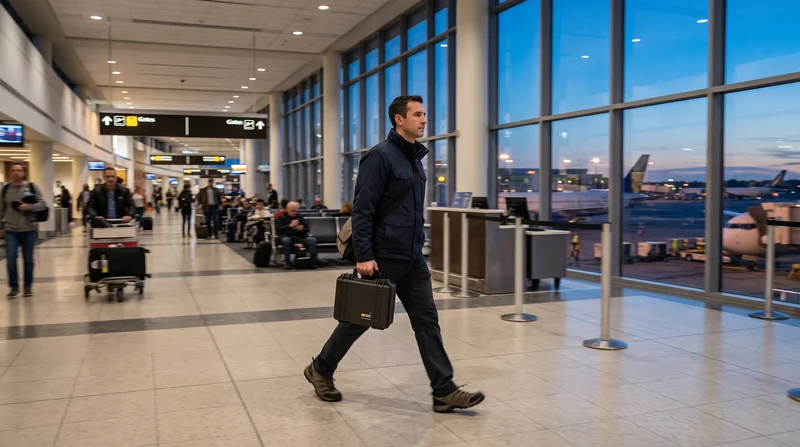
An on-board courier, sometimes called hand carry service, is a person who buys a seat, carries the shipment as carry-on or checked baggage, and delivers it personally at the other end. If the item fits in the cabin, the courier keeps eyes on it the whole trip. Checked items travel as ordinary luggage, which CNW says has minimal tracking. Our on-board courier guide covers OBC in more depth.
Ground rush
A ground rush is one vehicle going straight from pickup to delivery: a car or van on a same-day courier run, or hot shot trucking for pallets. No airline, no cutoff time. The limit is road miles per hour.
So “which is faster” really means how much time each handoff costs.
Airline cargo cutoffs and recovery times
NFO speed is set less by the flight than by the time the airline needs before and after it. Each carrier publishes its own tender (drop-off) and recovery windows by product and airport.
American Airlines Cargo’s ExpediteFS page is one published example. Domestic bulk freight has to be dropped off 120 minutes before departure at most stations (150 at Miami, 60 for screened freight at Phoenix), and recovery is listed at 120 minutes after arrival. Shipments that finish acceptance after the cutoff may move to the next available flight.
Small-package products recover faster. Delta Cargo’s DASH page offers a 50% refund if a pre-booked shipment isn’t available within 60 minutes of actual arrival, and adds 30 minutes of acceptance time for small packages containing dangerous goods.
An OBC plays by passenger rules. Delta’s domestic check-in page requires bags checked 45 minutes before departure and passengers at the gate 15 minutes before. That’s a shorter lead time than a cargo counter, but the courier still has to clear the checkpoint and find an open seat.
| Step | NFO (example: AA ExpediteFS, domestic) | OBC (example: Delta domestic passenger) |
|---|---|---|
| Latest arrival before departure | 120 minutes at most stations (bulk) | Bag check 45 minutes; gate 15 minutes |
| Who holds the item in flight | Airline cargo | The courier |
| Availability after landing | 120 minutes at AA cargo facility | As soon as the courier deplanes (plus bag claim if checked) |
| Dangerous goods | Only dry ice and Biological Substances, Category B on this product | Passenger baggage rules (FAA PackSafe) |
Those windows are published minimums. Confirm the current cutoff with the carrier or your courier on the day you ship, because stations and products change.
Security screening, customs and dangerous goods
TSA rules for air cargo
According to TSA’s cargo programs page, 100% of cargo on passenger aircraft must be screened at a level matching checked-baggage screening, and cargo from shippers who won’t consent to search is refused.
Most NFO shipments reach the airline through an indirect air carrier (IAC), a company that moves cargo by air without an FAA air carrier certificate and must run a TSA-approved security program renewed every year. Under 49 CFR 1548.17, an IAC checks each shipper’s validity and keeps known shipper cargo separate from unknown shipper cargo.
That matters because a first-time shipper may be “unknown,” which limits what can fly. Delta’s DASH page says anyone can ship packages under 16 ounces, while TSA Known Shippers can ship up to 100 pounds each. If your company has never shipped air cargo, raise it with your courier early.
Customs for an international OBC
When an on-board courier crosses a border, the goods have to be declared like any traveler’s commercial items. CBP’s page on traveling with samples explains that an ATA carnet is valid for one year and guarantees duties if the goods aren’t re-exported. That fits demo units and trade-show equipment. A part that will be installed and stay abroad isn’t coming back, so plan for normal import clearance and let your customs broker make the call.
Dangerous goods limits
Here the two air modes diverge sharply. An OBC’s bag is passenger baggage, and FAA’s PackSafe guidance says most dangerous goods are forbidden in carry-on and checked bags. Lithium battery devices above 160 watt-hours aren’t allowed on passenger aircraft at all. Cargo products allow more, through the airline’s DG program and with added acceptance time. If your part contains batteries or compressed gas, settle DG classification before you pick a mode.
When a ground rush beats flying
Flying feels faster. On short hauls it often isn’t, once you add counter times at both ends.
We ran two common Southern California lanes. Road distances and free-flow drive times come from the OSRM routing engine, downtown Los Angeles to downtown Phoenix, and downtown Los Angeles to Las Vegas. OSRM ignores traffic, so real drives run longer. Scheduled flight times on FlightAware for LAX to PHX and LAX to LAS mostly ran about 1:25 to 1:40 and 1:10 to 1:25.
For NFO we assumed 45 minutes from pickup to the LAX cargo counter, the 120-minute ExpediteFS drop-off and recovery windows, 30 minutes to the consignee, and a flight with space leaving right at the cutoff (the best case).
| Lane (from downtown LA) | Ground rush | NFO best case (assumptions above) |
|---|---|---|
| Las Vegas | About 270 miles, about 5 hours before traffic | 0:45 + 2:00 + about 1:15 + 2:00 + 0:30 = about 6.5 hours |
| Phoenix | About 373 miles, about 6.7 hours before traffic | 0:45 + 2:00 + about 1:30 + 2:00 + 0:30 = about 6.75 hours |
Las Vegas goes to the driver even with traffic. Phoenix is roughly a tie, and the tie usually breaks toward the ground because the driver leaves the minute the item is ready. NFO has to wait for a flight with space, and a missed cutoff can cost hours.
Air pulls ahead once the drive runs past seven or eight hours, or when a small-package product with a 60-minute recovery window serves the lane. Ground stays ahead for oversized or DG-restricted items, and for anything that shouldn’t leave a person’s custody but doesn’t justify a plane ticket.
Next flight out vs on board courier: a decision table
This is how we’d sort a request. Treat it as a starting point for a call with dispatch.
| Your situation | Usually the best fit | Why |
|---|---|---|
| Under about 5 to 6 hours of driving | Ground rush | No cutoff times, one handoff, leaves immediately |
| Long domestic lane, item can travel as cargo | NFO | Cheaper than OBC, scan-based tracking |
| Item must never leave a person’s custody | OBC | Courier holds it the whole trip if it fits in the cabin |
| International, customs paperwork needs a person on arrival | OBC | Courier clears and delivers the same day |
| Contains batteries, fluids or regulated DG | NFO through the airline’s DG program, or ground | Passenger baggage rules forbid most DG |
| Oversize or palletized freight | NFO widebody or hot shot | Too big for a passenger bag; ExpediteFS caps narrowbody pieces at 350 lbs |
| Shipper isn’t a TSA Known Shipper and item is heavier than 16 oz | Ground, or OBC | Unknown shippers face limits on passenger-aircraft cargo |
Cost follows the same pattern. The one published comparison we found, a 2018 CNW Global article, put small domestic OBC shipments at about $2,000 to $4,000 against $500 to $1,200 for NFO, and international OBC at $5,000 to $8,000 against $1,000 to $2,000. CNW blames the gap on the last-minute ticket, a hotel and the courier’s pay. They’re one company’s 2018 figures, so read them as proportions, not a quote.
What to ask your courier before you book
Start with dimensions, weight and contents, including batteries, fluids or dry ice. That answer alone can rule out OBC. For NFO, ask which flight they plan to use, the counter cutoff at that station, and the fallback if the item misses it. For OBC, ask whether the item rides in the cabin and whether a backup flight is picked out.
Then ask about the ground legs: who picks up, who recovers at the destination, and how long each takes at that hour. On Southern California lanes the answer is sometimes “send a driver now,” which is why we quote next flight out, on-board courier and hot shot options side by side. Aviation customers can start at our AOG shipments page.
Last, ask what proof of delivery you’ll get (signed name, time stamp, photo) and for the air waybill number on NFO shipments so you can track the airline leg yourself.
Related guides: for aircraft parts specifically, read what AOG means and how an AOG courier works. Anything containing batteries or dry ice should be checked against the IATA DGR 2027 changes, and our courier pricing guide breaks down what drives the cost of each option.
Frequently asked questions
Is an on-board courier faster than next flight out?
Not always. Both usually ride the same flights. An OBC skips the cargo counter and recovery windows, which can save a few hours at each end, but the courier needs an open seat and must clear TSA. CNW’s 2018 article says both options typically offer the same timeframe, with OBC costing more because of airfare, lodging and courier pay.
What is hand carry service?
Hand carry service is another name for an on-board courier. A person travels as a passenger with your shipment, keeps it as carry-on when possible, and delivers it by hand. It’s common for aircraft parts, legal originals and high-value items. Because the item is passenger baggage, FAA dangerous goods rules for baggage apply to it.
Do I need to be a TSA Known Shipper for NFO?
It depends on size and the airline product. Delta’s DASH page says anyone can ship packages under 16 ounces, while TSA Known Shippers can ship packages up to 100 pounds each. Indirect air carriers must vet shippers under 49 CFR 1548.17. Ask your courier to check your status before the shipment is ready.
Can an OBC carry lithium batteries or chemicals?
Very limited. FAA PackSafe guidance says most dangerous goods are forbidden in carry-on and checked bags, and battery devices over 160 watt-hours aren’t allowed on passenger aircraft at all. Parts with fluids, gases or larger batteries usually need to move as declared cargo under an airline’s DG program, or by ground.
Do I need an ATA carnet for an international hand carry?
Only if the goods are going out temporarily and coming back, such as demo equipment or trade-show samples. CBP describes the carnet as a one-year document that guarantees duties if goods aren’t re-exported. A part that stays abroad needs normal import clearance. Your customs broker should confirm the right entry type.
When should I just send a driver?
When the drive is shorter than the air process. From downtown Los Angeles, Las Vegas is about 270 road miles and Phoenix about 373. After adding cargo counter and recovery windows, a direct driver usually matches or beats NFO on those lanes and avoids cutoff risk entirely.
Power House Courier runs HIPAA-compliant, UN3373-certified specimen and medical deliveries 24/7 across California, Arizona and Texas. A dispatcher answers in under 15 minutes.
Sources
- CNW Global: Next Flight Out vs. On-Board Courier: Which Is Best? (August 2018)
- American Airlines Cargo: ExpediteFS
- Delta Cargo: DASH domestic small package express service
- Delta Air Lines: U.S. domestic check-in requirements
- TSA: Cargo Programs
- 49 CFR 1548.17: Known shipper program (Cornell LII)
- FAA: PackSafe for Passengers
- U.S. Customs and Border Protection: Traveling with Samples
- OSRM route: downtown Los Angeles to downtown Phoenix
- OSRM route: downtown Los Angeles to Las Vegas
- FlightAware: LAX to PHX flight finder
- FlightAware: LAX to LAS flight finder
Need something moved today and not sure which mode fits? Call dispatch 24/7 at (323) 744-1900 or request a quote.
Last reviewed: September 2026 by the Power House Courier dispatch team.

Critical logistics across the USA — same day courier, medical, legal, AoG, and nationwide trucking. Available 24/7.