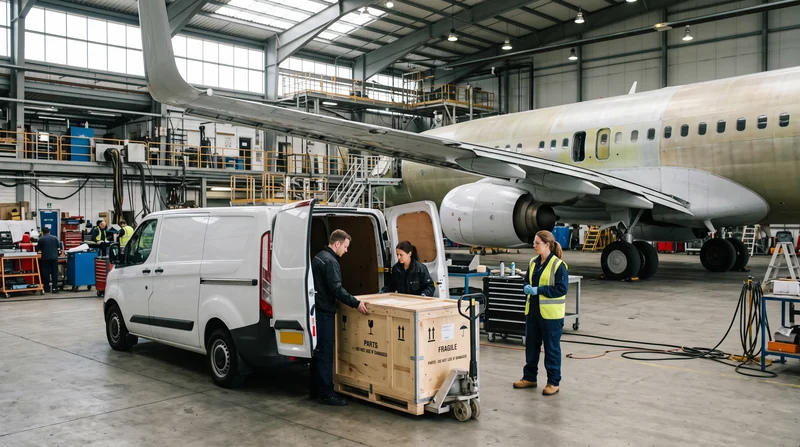
AOG stands for aircraft on ground: an aircraft that can’t legally or safely fly until a part is replaced or a repair is signed off. An AOG courier moves that part from wherever it sits (a supplier’s shelf, an MRO shop, another airport’s stores room) to the mechanic who needs it, by the fastest mode that will actually work.
Most AOG content online is written by parts suppliers and freight forwarders. This guide is written from the courier’s side of the phone, for the airports in Los Angeles, Phoenix and Las Vegas.
If a tail is down right now, skip to the checklist in the section on what to have ready. It saves the most time.
Power House Courier runs HIPAA-compliant, UN3373-certified specimen and medical deliveries 24/7 across California, Arizona and Texas. A dispatcher answers in under 15 minutes.
TL;DR
- AOG is the top spares priority and is reserved for an aircraft that is actually grounded; “critical” usually means a grounding or work stoppage is close but hasn’t happened yet.
- Boeing has estimated that an AOG event can cost an airline $10,000 to $150,000 per hour, depending on aircraft type and route.
- An AOG courier generally chooses between a dedicated ground hot shot, a next-flight-out airline shipment and an on-board courier who hand carries the part.
- Chemical oxygen generators are forbidden on passenger aircraft under 49 CFR 173.168, and standalone lithium-ion batteries need special approval to fly on one, which rules out some air options.
- Having the part number, dimensions, DG status, release paperwork and airside contact ready before you call is the fastest way to shorten the event.
What AOG means, and how it differs from critical and routine orders
An aircraft is AOG when it is temporarily unairworthy. A cracked window, a failed starter or a deferred item that has run out of time can all put it there. Until the part is fitted and the work is signed off, the airplane stays parked.
Parts orders carry a priority, and the priority drives how fast everyone moves. Sample spares contract clauses published by Law Insider describe AOG as the highest spares priority, reserved for an aircraft that is actually grounded, with the seller committing to a delivery plan within one hour. The level below, critical, covers parts needed urgently when no AOG exists yet but one is imminent or a work stoppage could follow; the same sample language gives the seller one working day to commit. Routine orders are everything else, shipped by normal freight.
For a courier, the priority sets the plan. An AOG call gets a driver dispatched now and a decision on mode within minutes. A critical order might ride that evening’s scheduled run. A routine order usually doesn’t need a dedicated courier at all.
Some shops call everything AOG because it gets a faster answer. That habit wears thin, and it makes the real groundings harder to spot.
Why every hour of an AOG event gets counted
A grounded aircraft keeps costing money while earning nothing, and the disruption spreads to rebooked passengers and crews who time out waiting.
The most quoted estimate comes from Boeing. As cited in the Wikipedia entry on aircraft on ground, Boeing’s operations center estimated that a one-to-two-hour AOG event can cost $10,000 to $20,000, and possibly as much as $150,000 per hour depending on aircraft type and route. The figure is old and the range is wide, so treat it as a sense of scale.
What matters for logistics is that downtime is counted by the hour. A courier charge that looks high on its own is often small next to one more rotation lost, which is why the cheapest mode is rarely right during a true AOG.
Ground hot shot, next flight out or on-board courier
Every AOG move comes down to three options, sometimes combined. The right one depends on distance, the part’s size and DG status, the time of day and the flight schedule between the two cities.
Dedicated ground hot shot
A driver picks up the part and drives it straight to the aircraft or receiving hangar, with no stops and no transfers. Inside Southern California this is almost always the fastest mode, because there’s no airline cutoff and no cargo counter queue. Between Los Angeles, Phoenix and Las Vegas it’s often competitive with flying once you add the drive to the airport, cargo tender time and recovery at the other end. Ground is also the only option for oversize items and for dangerous goods that airlines won’t accept.
Next flight out
With next flight out, the courier tenders the part to an airline’s priority cargo service on the first available flight, and a second driver recovers it at the destination. It’s the standard choice when a same-day drive won’t work. The weak points are the handoffs: a missed cutoff, a flight that goes out full, or a slow release at the destination cargo office.
On-board courier (hand carry)
An on-board courier buys a passenger seat and carries the part as baggage, staying with it the whole way. That removes the cargo handoff risk, which is why it’s common for small, high-value items and international moves. The limit is what a passenger can legally carry. Our on-board courier guide covers how those trips are planned.
| Mode | Best fit | Main limits | Custody |
|---|---|---|---|
| Ground hot shot | LA basin moves, LA to Phoenix or Las Vegas, oversize or DG parts | Drive time grows with distance; freeway traffic | One driver, door to door |
| Next flight out | Long distances where a same-day drive won’t work | Cargo cutoffs, space on the flight, recovery wait | Airline holds the part in flight; drivers at each end |
| On-board courier | Small, high-value parts and international moves | Passenger baggage and DG rules; seat availability | One person with the part the whole trip |
When the answer isn’t obvious, a good dispatcher will time two options side by side. If the hot shot lands at 4 p.m. and the flight lands at 2:30 p.m. with some risk of a missed cutoff, you should make that call with both numbers in front of you.
What to have ready when you call an AOG courier
Most time lost in an AOG move is lost before a driver turns a wheel, waiting on a dock address, a released part or someone to open a gate. Put these details in one message:
- Part number, serial number if relevant, and a short description.
- Packed dimensions and weight, including any container or shipping stand.
- Whether the part is or contains dangerous goods.
- Pickup address, dock or counter, hours, and a named contact with a mobile number.
- Delivery point (hangar, FBO, ramp position or cargo office) and a named receiver.
- Airside access details, including who will escort the driver.
- Where the release paperwork is and who is holding it.
Dangerous goods change the plan
Aircraft parts include plenty of regulated items: batteries, oxygen equipment, fire extinguisher bottles and anything with a pressurized cylinder may be dangerous goods. Two examples show how much this affects mode choice. Under 49 CFR 173.168, a chemical oxygen generator is forbidden on a passenger-carrying aircraft, and expired or spent units can’t go on cargo aircraft either. The IATA 2026 lithium battery guidance document says lithium-ion batteries packed by themselves must ship at no more than 30% state of charge and can’t go on a passenger aircraft without approval from the relevant authorities.
So an oxygen generator can’t go by hand carry or on a passenger airline’s next flight out. The answer is usually ground, or a declared cargo-aircraft shipment handled by DG-trained staff. Tell your courier the DG status on the first call and have your own DG program confirm classification and packaging, because the shipper is responsible for the declaration.
Release paperwork travels with the part
Mechanics generally won’t install a part without its airworthiness release. In the US that’s usually FAA Form 8130-3, the Authorized Release Certificate, Airworthiness Approval Tag. The FAA’s current instructions for completing it on newly produced parts are in FAA Order 8130.21J, and repair stations also use the form when they release a part after maintenance. The European equivalent is the EASA Form 1, which EASA describes as the certificate stating that a part was manufactured in accordance with its design data.
For delivery, confirm the paperwork is with the part, or already emailed to the receiving mechanic, before the driver leaves. A part that arrives without its tag can sit on a bench for hours.
AOG delivery at LAX, BUR, VNY, ONT, PHX and LAS
The biggest difference between airports is access. Under 49 CFR 1542.205, airports must run a Security Identification Display Area, and unescorted access to it requires a background check and training. A courier without an airport badge needs an escort, a meet at the gate or a handoff at a landside door. Sort that out before the driver reaches the guard shack.
At LAX, AOG work usually ends at an airline maintenance hangar, a line station office or a cargo facility, and drive time from inside the basin depends heavily on the hour. At Burbank (BUR) and Van Nuys (VNY), the receiving end is often an FBO or private hangar with its own gate rules, so get the FBO name and not just the airport code. Ontario (ONT) is a natural drop point for parts coming out of Inland Empire warehouses, since the driver never has to cross the basin.
Phoenix Sky Harbor (PHX) and Harry Reid International (LAS) both take LA-origin parts by ground when the timing works. We covered the Phoenix side in our post on AOG courier work at Sky Harbor, and the same questions apply in Las Vegas: which door to use and who signs.
MRO shops add another layer, because each repair station and line station keeps its own receiving hours. Knowing them can save a day.
How to set up an AOG courier before the next event
The smoothest AOG moves happen when contacts and access were set up during a quiet week. A short onboarding call with your courier should cover who can authorize a move after hours and how you want updates (a text or a call at each handoff). It should also record your usual pickup and delivery points with gate procedures, and list the DG parts you ship often so dispatch never has to ask twice.
When comparing couriers, ask how they decide between ground and air on a given job, whether dispatch answers around the clock, and whether they’ll show you timing for more than one mode. Our AOG shipments and aviation industry pages explain how we handle these calls, and hot shot trucking covers larger items that won’t fit in a car.
After each event, send the courier notes on what slowed things down.
Related guides: our comparison of next flight out, on-board courier and ground rush goes deeper on choosing a mode, and the 2027 IATA DGR changes explain new rules for batteries and other regulated aircraft parts.
Frequently asked questions
What does an AOG courier do?
An AOG courier picks up a part needed to return a grounded aircraft to service and delivers it by the fastest workable route. That can mean driving it directly, tendering it to an airline and recovering it at the other end, or sending a person to hand carry it.
Is next flight out always faster than driving?
No. Inside Southern California, and often between Los Angeles and Phoenix or Las Vegas, a direct drive can match a flight once you count the drive to the airport, cargo cutoff and recovery. For longer distances, flying usually wins. Ask your courier for timing on both.
Can an on-board courier carry any aircraft part?
No. Hand-carried parts must fit passenger baggage limits, and dangerous goods rules apply. Chemical oxygen generators are forbidden on passenger aircraft, and standalone lithium-ion batteries need special approval. Your DG staff should confirm classification before a hand carry is booked.
What paperwork should travel with an AOG part?
The airworthiness release, usually FAA Form 8130-3 in the US or EASA Form 1 for parts released under EASA rules, plus the packing list and any DG declaration. Check with the receiving mechanic what they need before the part leaves, and email copies ahead where you can.
Can a courier deliver directly to the aircraft on the ramp?
Only when access is arranged. Ramps at commercial airports usually sit inside a secured area where unescorted access requires an airport-issued badge. Without one, the driver needs an escort or a handoff at a gate. Set this up with the airport tenant or FBO in advance.
How much does an AOG courier cost?
Price depends on distance, mode, vehicle size, time of day and any wait or recovery time. Ask for a quote with timing for each mode, so you can weigh cost against the hourly cost of the aircraft sitting.
Power House Courier runs HIPAA-compliant, UN3373-certified specimen and medical deliveries 24/7 across California, Arizona and Texas. A dispatcher answers in under 15 minutes.
Sources
- Aircraft on ground (Wikipedia, citing Boeing Commercial Airplanes Operations Center)
- Aircraft on Ground (AOG) sample clauses, Law Insider
- FAA Form 8130-3, Authorized Release Certificate, Airworthiness Approval Tag (FAA)
- FAA Order 8130.21J, Completion of FAA Form 8130-3 under Part 21
- EASA FAQ: What is an EASA Form 1?
- 49 CFR 173.168, Chemical oxygen generators (Cornell LII)
- IATA Battery Guidance Document, revised for the 2026 regulations
- 49 CFR 1542.205, Security of the security identification display area (Cornell LII)
Have a tail down or a critical part to move? Call dispatch at (323) 744-1900 or request a quote.
Last reviewed: September 2026 by the Power House Courier dispatch team.

Critical logistics across the USA — same day courier, medical, legal, AoG, and nationwide trucking. Available 24/7.