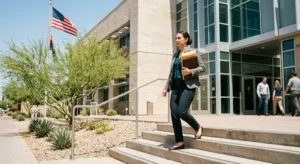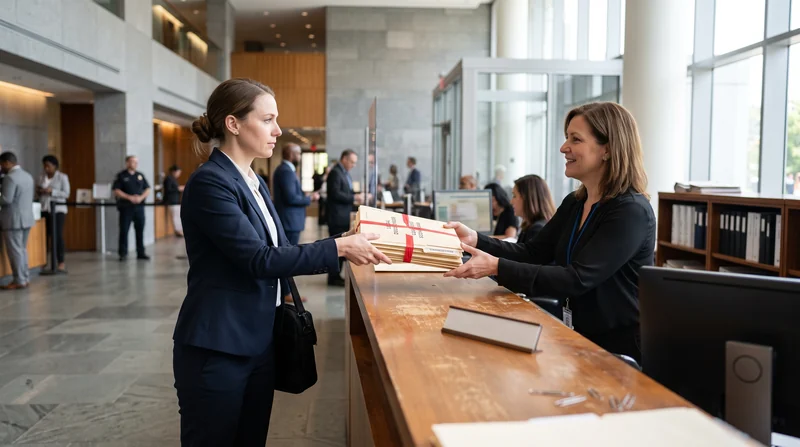
Legal courier companies move court filings, exhibits, deposition materials and signed originals between law offices, courthouses, agencies and opposing counsel, and they return stamped proof that the delivery happened. They are not the same as a registered process server, and they are not the same as a general delivery app, which is where most firms get the selection wrong.
Electronic filing was supposed to make these companies unnecessary. It did not. Courts still refuse electronic submission for whole categories of documents, and someone has to physically carry those to the clerk before the window closes.
This guide covers what separates one legal courier from another, which provider type you actually need for a given task, and the questions that tell you in about ninety seconds whether a company files at your courthouse regularly or is guessing.
Power House Courier runs HIPAA-compliant, UN3373-certified specimen and medical deliveries 24/7 across California, Arizona and Texas. A dispatcher answers in under 15 minutes.
TL;DR
- A legal courier delivers and files documents and returns conformed copies, while serving a summons on a person is separate, regulated work.
- In California, anyone at least 18 and not a party to the action may serve a summons, but a person who makes more than 10 services of process in a calendar year for compensation must register as a process server.
- Mandatory e-filing did not eliminate physical filing. Orange County Superior Court still requires paper for bench warrants, subpoenaed documents, bond payments, undertakings and original wills.
- The most useful screening question is how often the company files at your specific courthouse, because clerk window hours change and current knowledge only comes from going there.
- Proof of delivery with a timestamp and location beats a signature on a form, because that is the record you will rely on if timeliness is challenged.
What a legal courier company actually does
The job has four parts. Collect the documents from your office. Deliver them to the right counter at the right building before a specific cutoff. Wait for the clerk to process them. Bring back a conformed copy bearing the stamp.
That last part is what firms underestimate. A delivery confirmation tells you a package arrived somewhere. A conformed copy tells you the court accepted the filing, on what date, and in what condition. Those are different records, and only one of them helps you later.
Beyond filings, the same companies carry courtesy copies to judicial chambers, deposition transcripts to court reporters, exhibits to and from storage, and signed originals between parties. Evidence transport usually comes with a chain of custody log showing every handoff, the time, and who signed.
What a legal courier does not do is give advice about whether your filing is correct. A driver who files daily will often spot an obvious formatting problem at pickup, which is worth something, but responsibility for the document stays with the firm.
Why electronic filing did not end physical filing
California courts may require electronic filing by local rule under California Rules of Court rule 2.253, and many have. The rule carries exemptions that matter in practice. Self-represented parties are exempt from mandatory electronic filing, and a party can be excused on a showing of undue hardship or significant prejudice.
Electronic filing systems also do not accept everything. Orange County Superior Court lists documents that must still be submitted in paper or lodged physically, including bench warrants, subpoenaed documents, bond payments, undertakings, original wills offered for filing or safekeeping, and Labor Commissioner cash or check deposits.
Read that list again with a courier in mind. Original wills. Bonds. Undertakings. Subpoenaed documents. These are exactly the items where a lost or late delivery is expensive, and they are the items a portal cannot take.
Trial exhibits are the other recurring case. Volume alone defeats electronic submission, and courts frequently want the physical set.
Where courier work stops and process service begins
Firms routinely ask a courier to serve opposing counsel or a witness. Sometimes that is fine and sometimes it creates a defect in service, so the distinction is worth knowing precisely.
Under California Code of Civil Procedure section 414.10, a summons may be served by any person who is at least 18 years of age and not a party to the action. Federal practice reads almost identically. Rule 4(c)(2) of the Federal Rules of Civil Procedure provides that any person who is at least 18 years old and not a party may serve a summons and complaint.
So a courier can lawfully serve, in the narrow sense. The complication is volume. California Business and Professions Code section 22350 requires any natural person who makes more than 10 services of process in the state during one calendar year, for compensation directly attributable to that service, to file and maintain a verified certificate of registration as a process server. Corporations and partnerships deriving compensation from process service must register regardless of volume.
A courier company that serves process routinely is therefore operating as a process server and should be registered. If a company says it serves process, ask for the registration. If it says it does not, that is a straight answer, and it tells you to book a registered server separately while the courier handles the filing, the courtesy copies and the retrieval on the same run.
Which provider type you need
Most selection mistakes come from treating four different services as one. This is the shape of the market.
| Provider type | Use it for | Do not use it for | What to verify |
|---|---|---|---|
| General delivery app | Routine office to office parcels with no deadline | Court filings, exhibits, anything with a cutoff | Nothing. Assume no courthouse access or knowledge. |
| Legal courier | Filings, conformed copy returns, courtesy copies, exhibit and evidence transport | Serving a summons on a person at volume | Filing frequency at your courthouse, insurance for document handling, timestamped proof of delivery |
| Registered process server | Service of summons, subpoenas and similar process | Bulk filing runs where service is not required | Certificate of registration number and county of registration |
| Electronic filing service provider | Documents the court accepts electronically | Bonds, undertakings, original wills, subpoenaed documents, exhibits | Whether the court approves that provider |
Plenty of matters need two of these on the same day. A motion gets filed electronically, the courtesy copy goes to chambers by hand, and a subpoena goes to a registered server. One vendor rarely covers all three well, and a company claiming it does deserves a follow up question.
How to compare legal courier companies
Start with courthouse familiarity, because nothing else compensates for it. Ask how often the company files at the specific court you use most. If the answer requires checking, they do not file there regularly.
Clerk window hours are the reason this matters. Hours differ between buildings in the same county, they change, and court websites lag behind the change. A company that files at a given courthouse several times a week knows the current cutoff from having stood in the line. That knowledge has a short shelf life and cannot be looked up reliably.
Next, look at what the proof of delivery contains. A name scrawled on a form is weak. A record with date, time and location data is the thing you produce when opposing counsel questions whether a filing was timely. Ask to see a sample before you need one.
Insurance is the third item, and it is specific. General delivery insurance is written for parcels. It does not contemplate the exposure of a lost court filing, a missing original, or mishandled evidence. Ask what the policy covers for document loss.
Then dispatch hours. Filing deadlines do not respect business hours, and the gap between a 5pm dispatch closure and a document that has to move at 7pm is where emergencies live. Ask whether a person answers after hours or whether you reach a recording.
Conformed copy turnaround is the last one. Same day is the standard. A quoted turnaround of one to two business days means runs are being batched and your filing waits in a queue behind other work.
Working with a legal courier on a deadline
Give the courier three things at booking: the court, the specific filing type, and the cutoff you are working to. Filing hours sometimes differ from general operating hours for the same building, so a dispatcher who confirms the filing window rather than the building hours is doing the job properly.
Say explicitly what you need back. A conformed copy scanned from the courthouse and emailed within minutes is a different request from a physical copy returned by end of day, and both are usually available if you ask at booking rather than afterwards.
Flag anything unusual before pickup. Oversized exhibit sets, items that must be lodged rather than filed, and documents heading to a judge’s chambers all have their own handling, and a courier told in advance can plan the route around them.
Power House Courier runs legal courier service across Los Angeles and legal courier service in Phoenix, with 24/7 dispatch and conformed copy returns. Firms with recurring volume usually move to a B2B courier account so bookings and invoicing stay in one place. If you also need documents moved between offices on short notice, that falls under same day courier service.
For a closer look at the court run itself, including what gets checked at the counter, see our guide to legal document courier services.
Frequently asked questions
Can a legal courier serve a summons for me?
Legally, any person at least 18 years old and not a party to the action may serve a summons in California and in federal court. In practice, a courier who serves more than 10 times a year for compensation must register as a process server in California. Ask for the registration number, or book a registered server separately.
If my court requires e-filing, do I still need a courier?
Usually yes. Courts exclude categories of documents from electronic filing. Orange County Superior Court still requires paper for bench warrants, subpoenaed documents, bond payments, undertakings and original wills. Trial exhibits are commonly physical too, and courtesy copies for chambers are often delivered by hand.
What is a conformed copy and why does it matter?
A conformed copy is your document bearing the clerk’s stamp showing it was accepted and when. A delivery confirmation only proves a package arrived somewhere. The conformed copy is the record your file needs if the timeliness of a filing is ever questioned, which is why same day return is worth asking about.
How far ahead should I book a court filing run?
Earlier is better, but the practical answer depends on distance and the cutoff. Give the dispatcher the court, the filing type and your deadline at booking. A good dispatcher will confirm the filing window for that document type at that building rather than quoting general operating hours.
What insurance should a legal courier carry?
Ask specifically about coverage for document loss and evidence handling, not general parcel insurance. Standard delivery coverage is written for goods and does not contemplate the exposure created by a lost original, a missing exhibit or a filing that never reached the counter.
Can one company handle filing, service and electronic submission?
Some can, but verify each capability separately. Filing and service are different jobs with different rules, and electronic filing service providers have to be approved by the court. A single vendor claiming all three is worth a follow up question about registration and court approval.
Power House Courier runs HIPAA-compliant, UN3373-certified specimen and medical deliveries 24/7 across California, Arizona and Texas. A dispatcher answers in under 15 minutes.
Sources
- California Code of Civil Procedure section 414.10
- California Business and Professions Code section 22350
- Federal Rules of Civil Procedure, Rule 4
- California Rules of Court, rule 2.253
- Orange County Superior Court, eFiling FAQs
If you have a filing that has to be stamped today, call (323) 744-1900 and speak to a dispatcher, or request a quote.
Last reviewed: September 2026 by the Power House Courier dispatch team.

Critical logistics across the USA — same day courier, medical, legal, AoG, and nationwide trucking. Available 24/7.