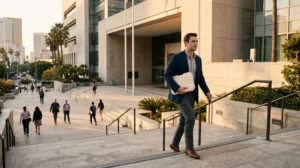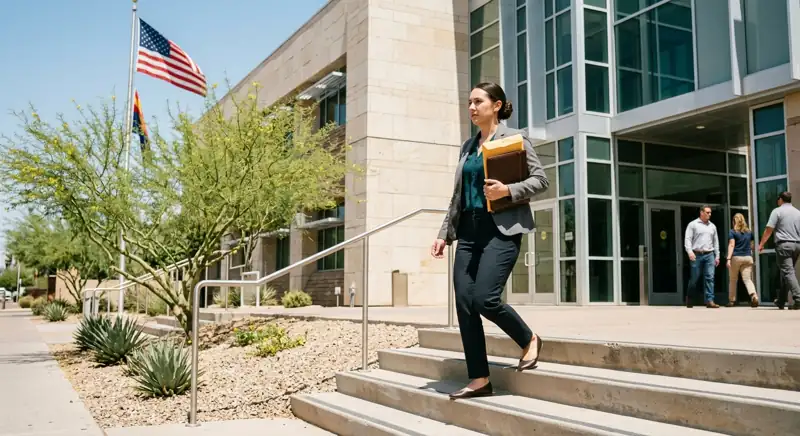
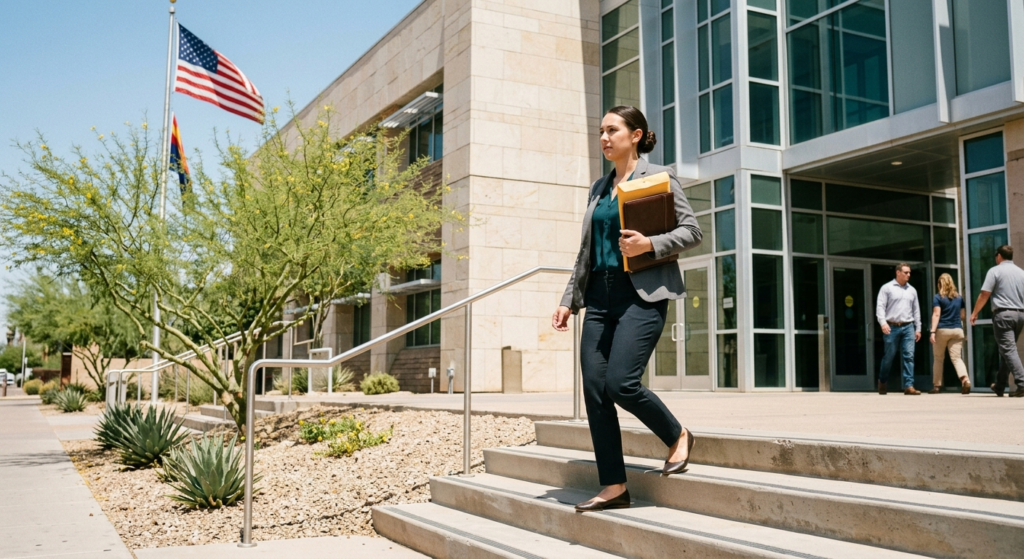
A paralegal at a mid-size Phoenix firm called us last year at 3:47pm. She had a motion that needed to be filed at Maricopa County Superior Court before the 4pm clerk window closed. Her regular courier, a general delivery app, had marked the pickup as “pending” for forty minutes.
We had a driver at her office on 44th Street by 3:58pm. The motion was stamped at 4:11pm. The clerk window had actually stayed open until 4:15 that day. She didn’t know that. Neither did her courier app.
That’s the difference between a legal courier and a delivery service. One knows the courthouse. The other knows your address.
Power House Courier runs HIPAA-compliant, UN3373-certified specimen and medical deliveries 24/7 across California, Arizona and Texas. A dispatcher answers in under 15 minutes.
The Courthouse Knowledge Gap
Maricopa County Superior Court operates out of four locations. The Central Court Building on West Jefferson handles most civil filings. The Southeast Facility in Mesa covers the East Valley. The Northeast Facility near Scottsdale Road takes cases from that jurisdiction. The Northwest Facility in Surprise handles the rapidly growing West Valley caseload.
Each location has different clerk window hours. Some close at 4pm. Some accept filings until 5pm. The hours change periodically and the court’s website doesn’t always reflect reality the same week a change takes effect.
A legal courier who files at these locations regularly knows the current hours from direct experience. Not from a website. Not from what the hours were last month. From walking into the building yesterday.
The Sandra Day O’Connor Federal Courthouse on West Washington has its own filing procedures, its own security screening process, and its own quirks around document formatting requirements. Arizona Court of Appeals, Division One, on West Washington Street operates on yet another schedule. Knowing which building accepts what, and when, isn’t something you pick up from a training manual. It comes from running documents to these buildings five days a week.
What Goes Wrong With General Delivery Services
We’ve picked up work from law firms who switched to us after a filing went sideways. The patterns repeat.
The most common failure: the driver arrives at the wrong entrance. The Central Court Building has public entrances and a loading/delivery area. A courier who has never been there will follow GPS to the front, wait in the public security line, and burn fifteen minutes they didn’t have.
Second most common: the driver doesn’t have proper ID or can’t get through courthouse security. Some courthouses in the Valley require government-issued photo ID, not just a company badge. A driver who shows up with only a delivery app on their phone sometimes doesn’t get past the metal detectors.
Third: document formatting problems caught at the counter. Courts have specific requirements for caption format, page numbering, and hole-punch placement. A legal courier who files daily will flag obvious problems before leaving the law firm’s office. A general driver picks up a sealed envelope and delivers whatever is inside, formatting problems and all. By the time the clerk rejects the filing and the paralegal finds out, the deadline may have passed.
Courier Runs and Process Service Are Different Jobs
Firms sometimes ask a courier to “serve” opposing counsel or a witness. In Arizona, serving process on a person is regulated work. Anyone who serves a summons, subpoena, or similar process must be certified under Arizona Code of Judicial Administration § 7-204, a program the Supreme Court administers under A.R.S. § 12-3301 and Rule 4(e) of the Rules of Civil Procedure.
Power House Courier does not serve process in Arizona. We deliver documents to courts, law offices, agencies, and other parties, and we return stamped copies and signed proof of delivery. When a matter needs both, hire a certified process server for the service and send us the filing, the courtesy copies, and the retrieval on the same day. Keeping the two jobs separate protects the validity of your service and keeps the paper trail clean.
Timing Matters More Than You Think
A filing deadline is three things at once: a date, a time, and a specific clerk window at a specific building. Miss any one of those three and the filing fails.
We’ve seen firms lose continuances because a motion for extension was filed seventeen minutes after the clerk window closed. We’ve seen emergency TRO applications delayed by a day because the runner got stuck in I-10 construction traffic between Goodyear and downtown. We had one case where a firm’s internal mail room sat on a filing for two hours because they assumed “end of day” meant 5pm. The court’s definition of “end of day” for that filing type was 4pm.
When a firm calls us for a rush filing, the first thing our dispatcher does is confirm the specific court, the specific clerk window, and the current hours for that filing type at that location. Not the general operating hours. The filing hours. They’re sometimes different.
For the Central Court Building, we can usually get a filing picked up from anywhere in the Phoenix metro and stamped within two to three hours. From our Tempe office, the drive to the courthouse is about twenty minutes in normal traffic. Add pickup time, security, and the filing queue, and the realistic window is ninety minutes to two hours for a straightforward filing.
What a Legal Courier Run Actually Produces
Every legal courier run generates a documentation package. Not just a delivery confirmation. A package your file can reference.
For court filings: a conformed copy with the clerk’s stamp, returned to the firm the same day. If the firm needs it faster, we scan the conformed copy from the courthouse parking lot and email it before driving back. The physical copy follows.
For deliveries to counsel, witnesses, and court reporters: proof of delivery with the date, time, and the signature of the person who received the package.
For evidence and exhibit transport: a chain-of-custody log showing who picked up the material, what condition it was in, the route taken (GPS-logged), and who received it at the destination. Every handoff gets a signature, a timestamp, and a photo.
This documentation exists because at some point, someone is going to ask about it. A partner reviewing a billing entry. Opposing counsel challenging the timeliness of a filing. A judge asking when an exhibit left your custody. The paperwork answers those questions before they become problems.
What to Look For When Choosing a Legal Courier in Phoenix
Ask how often they file at the specific court you use most. If the answer involves checking, they don’t file there regularly.
Ask whether their drivers carry GPS tracking that logs pickup and delivery times. If the proof of delivery is just a name on a form with no time or location data, you’re relying entirely on the driver’s word.
Ask whether they’re bonded and insured specifically for legal document handling. General delivery insurance doesn’t cover the liability exposure of a lost court filing or a mishandled piece of evidence.
Ask about their dispatch hours. Filing deadlines don’t follow a 9-to-5 schedule. If their dispatch closes at 5pm, you have a gap.
Ask for a conformed copy turnaround time. Same day is standard. If they say “one to two business days,” they’re batching runs and your filing is sitting in a queue.
Ask whether they serve process. If they say yes, ask for the certificate number. If they say no, that’s the honest answer for most couriers, and it tells you to plan a certified server separately.
Power House Courier runs HIPAA-compliant, UN3373-certified specimen and medical deliveries 24/7 across California, Arizona and Texas. A dispatcher answers in under 15 minutes.
Our Coverage in the Phoenix Metro
We operate out of 1834 E Baseline Rd STE 107 in Tempe. That puts us roughly equidistant from the Central Court Building downtown, the Mesa municipal courts, and the Scottsdale courts. The I-10, Loop 101, and Loop 202 freeways are all within minutes of the office.
We file and deliver documents across the entire Maricopa County jurisdiction, including Phoenix, Scottsdale, Tempe, Mesa, Chandler, Gilbert, Glendale, Peoria, Surprise, Avondale, Goodyear, Fountain Hills, Cave Creek, Queen Creek, and San Tan Valley.
For courts outside Maricopa County, we coordinate runs to Pima County Superior Court in Tucson, Pinal County in Florence, and Yavapai County in Prescott. These are longer-distance runs and we quote them individually based on timing and distance.
Dispatch is staffed around the clock. The phone number is (323) 744-1900 and a dispatcher picks up, not a recording. For filing requests placed before 2pm, we can typically complete same-day filing at the Central Court Building. For after-hours and weekend work, we dispatch from the Tempe office with the same response time.
For a fuller walkthrough of what a court run involves and what to check before you book, read our guide to legal courier services in Phoenix.
Power House Courier provides bonded, insured legal courier service across the Phoenix Valley. Court filings, courtesy copies, deposition delivery, evidence transport. 24/7 dispatch from our Tempe office. Call (323) 744-1900 or request a quote.

Critical logistics across the USA — same day courier, medical, legal, AoG, and nationwide trucking. Available 24/7.