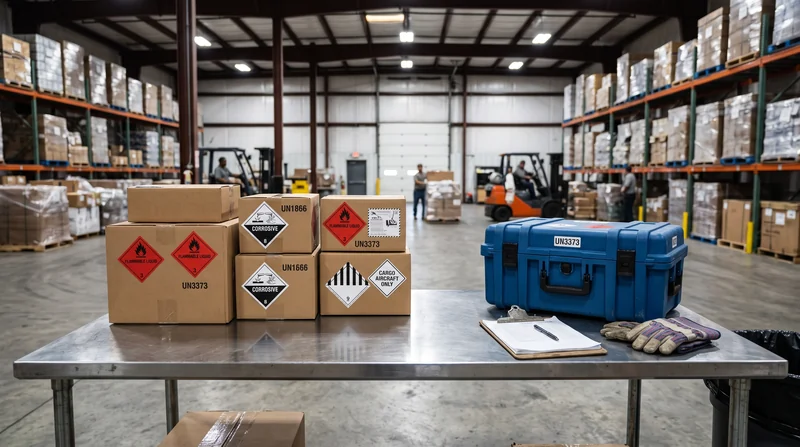
The IATA DGR 2027 changes arrive with the 68th edition of the Dangerous Goods Regulations, which takes effect on 1 January 2027. For specimen shippers the edition is fairly light, while aircraft parts and battery shippers get a longer to-do list: new sodium ion entries, amended lithium battery packing instructions, a retired battery mark and a cleanup of airline operator variations.
The full regulations are a paid publication, so we worked from IATA’s public significant changes list plus trainer commentary, and we only list changes confirmed there. IATA says the list “must not be considered an exhaustive listing,” so your dangerous goods (DG) program should still check the full text for the UN numbers you ship.
TL;DR
Power House Courier runs HIPAA-compliant, UN3373-certified specimen and medical deliveries 24/7 across California, Arizona and Texas. A dispatcher answers in under 15 minutes.
- The 68th edition of the IATA DGR takes effect on 1 January 2027 and incorporates the 2027-2028 ICAO Technical Instructions.
- For infectious substances, IATA’s summary lists a classification note at 3.6.2.2.2.1.3 and an amendment to Packing Instruction 650, but no headline rewrite of UN3373 or UN2814/UN2900 rules.
- Battery shippers see new entries UN3563 and UN3564, amended lithium and sodium ion packing instructions (965 through 970, plus 978) and the phase-out of the old battery mark with a phone number.
- US ground rules have not caught up yet: PHMSA’s HM-215R proposal (February 2026) would adopt the 2025-2026 ICAO Technical Instructions, not the 2027-2028 edition.
- IATA training guidance says recurrent DG training must be completed within 24 months of the previous training, so check expiry dates before the new edition starts.
IATA DGR 2027 changes at a glance
IATA publishes a new DGR every year. The 68th edition brings in all amendments from the ICAO Dangerous Goods Panel for the 2027-2028 Technical Instructions, plus changes adopted by the IATA Dangerous Goods Board. The table below pulls out the items most likely to touch a medical lab, a clinical trial site or an aviation maintenance shop.
| Section | What changed | Who should care |
|---|---|---|
| 1.2.7 | The in-aircraft exception now also covers blood and blood components for transfusion. The data logger exception now includes certain sodium ion batteries. | Transplant and transfusion logistics, cold chain shippers using loggers |
| 2.8.3 | Operator variations that only repeat the rules are deleted. Company-specific ones (IATA gives dry ice limits by aircraft type as an example) move to airline manuals. COMAT references are being removed. | MROs, airline stores, AOG desks |
| 3.6.2.2.2.1.3 | Notes that state bodies may give extra guidance on classifying infectious substances, relevant when deciding between UN3373 and UN2814/UN2900 in an emerging health situation. | Labs, specimen shippers |
| 3.9.2.6.1 and A235 | Classification of hybrid batteries made of lithium ion and sodium ion cells. | Battery and equipment shippers |
| 4.2 | New entries UN3563 (lithium metal batteries installed in cargo transport unit) and UN3564 (sodium ion batteries installed in cargo transport unit). | Equipment and battery shippers |
| Section 5 | Amended packing instructions include 650, 950 through 970, 972, 975 and 978. Many edits add sodium ion batteries or change prototype battery text. | Almost everyone |
| Section 7 | The old battery mark with a phone number is phased out. Where other hazard labels are required, the battery mark goes on the same surface. | Battery shippers |
| 8.1.6.9.2 | Step 6 of the second sequence for completing the Shipper’s Declaration was restructured and reworded. | Anyone signing a Shipper’s Declaration |
Labelmaster’s review of the 2027 significant changes paints the same picture: most of the weight sits with batteries, passenger rules and operator variations.
Specimen shipments: UN3373, UN2814 and UN2900
If your lab ships patient specimens by air, the 68th edition probably changes less than you expect.
IATA’s summary lists one classification item for Division 6.2. Paragraph 3.6.2.2.2.1.3 now points out that state-related entities may provide additional guidance on classifying infectious substances. IATA says this matters most in emerging health situations, when someone has to decide quickly whether material is UN3373 (Biological substance, Category B) or UN2814/UN2900 (Category A). During an outbreak, your classification call may lean on a public health authority’s guidance, so know where that guidance would come from before you need it.
Packing Instruction 650, which covers UN3373, is on IATA’s list of amended instructions. The summary doesn’t say what changed, and we couldn’t confirm the edit from a public source. Compare your packaging SOP against the new PI 650 text once your DG team has the 2027 book.
We found no Category A (PI 620) change in IATA’s summary. Separately, the 1.2.7 exception now includes blood and blood components for transfusion, mainly aimed at the equipment that keeps them viable.
Dry ice and cold chain packages
Dry ice (UN1845) is where many specimen and pharmaceutical shipments pick up a second hazard. IATA’s list of amended packing instructions does not include PI 954, the dry ice instruction, so we can’t point to a 2027 packing change for dry ice itself.
The change that could still bite is in operator variations. IATA says company-specific variations, and it names “dry ice limits by aircraft type” as the example, are better managed through each airline’s internal procedures and have been amended or deleted. So a dry ice limit you used to look up in the DGR’s operator variation pages may now live in the airline’s own manual. Ask your forwarder or airline which limits apply before you plan a large frozen consignment.
US rules sit in 49 CFR 173.217, which requires packaging that lets carbon dioxide gas escape and adds air-specific marking, including the net mass of dry ice. If a temperature-controlled courier handles the drive to the airport, the package should already be built to the air rules, since it flies next.
Batteries, sodium ion and aircraft parts
This is the busy part of the 68th edition, and it lands on aviation maintenance teams more than on labs.
Sodium ion batteries already had their own entries (UN3551 and UN3552) in the 2025-2026 ICAO Technical Instructions. The 68th edition adds UN3564 for sodium ion batteries installed in a cargo transport unit and UN3563 for the lithium metal equivalent. Five special provisions gain references to sodium batteries, and the new A235 covers hybrid batteries that mix sodium ion and lithium cells.
For section II lithium battery shipments under PI 967, 970 and 978 containing no more than four cells or two batteries, button cells in the equipment no longer count toward that limit. The old battery mark with a phone number is phased out; IATA says it “should not form the sole basis for rejection,” but shippers are encouraged to switch to the current mark.
The operator variation cleanup matters to aircraft parts in a specific way. Several airlines prohibited certain classes or UN numbers but made an exception for COMAT (company material) spares. IATA is removing COMAT references from the variations and has added a note under 2.5.2, with company procedures moving into airline manuals. If your AOG process relies on a COMAT exception, confirm with the airline how it will handle that part in 2027. A grounded aircraft is a bad time to find out.
How US ground rules line up
Inside the United States, the Hazardous Materials Regulations (49 CFR Parts 171 to 180) govern shipments. There’s a bridge: 49 CFR 171.24 lets a shipment go by aircraft, and by motor vehicle before or after the flight, under the ICAO Technical Instructions, subject to conditions in 171.22 and the rest of that section. That’s why a courier van carrying a package prepared to the air rules can usually run it to the airport as is.
The two rulebooks are not in sync, though. On 10 February 2026 PHMSA published a notice of proposed rulemaking, HM-215R, to harmonize the HMR with international standards. It would incorporate the 2025-2026 ICAO Technical Instructions (one edition behind DGR 68) and add HMR entries for sodium ion batteries. Comments closed on 13 April 2026, and IHMM reported that PHMSA had moved to reviewing comments and preparing a final rule. We did not find a published final rule when we checked in September 2026. Check federalregister.gov under docket PHMSA-2023-0111 before relying on it.
For road-only specimen work, 49 CFR 173.199 is the rule for Category B. It requires triple packaging and the UN3373 mark, and it says each person who offers or transports a Category B substance under that section “must know about the requirements of this section.” Road couriers work to 173.199; the IATA edition change doesn’t alter that ground-only obligation.
What to check before January 2027
Most of this is housekeeping. Start with training, because it has hard dates.
IATA’s Dangerous Goods Training Guidance says recurrent training “must be provided within 24 months of previous training.” If recurrent training is done within the final three months of validity, the new validity runs 24 months from the expiry month of the previous training. US hazmat employees also fall under 49 CFR 172.704, which Lion Technology summarizes as training repeated at least every three years. Air shippers usually follow the tighter 24-month cycle because airlines expect it.
Then work through the paperwork and packaging:
- Get the 68th edition (or your software update) into the hands of whoever signs Shipper’s Declarations, and review the reworded step at 8.1.6.9.2.
- Compare your PI 650 specimen SOP with the 2027 text, even though IATA’s summary doesn’t describe the change.
- Replace stock of the old battery mark with a phone number and train packers on label placement next to other hazard labels.
- For batteries shipped as aircraft parts, recheck packing instructions 965 through 970 and the new hybrid battery rules.
- Ask each airline you use where its dry ice limits and COMAT handling will live after the operator variation cleanup.
Working with a courier on DG shipments
A ground courier doesn’t classify your shipment or sign your Shipper’s Declaration. You, as the shipper, do. What a courier can do is keep a correctly prepared package intact and on time between your dock and the airline’s cargo counter, and refuse anything that plainly isn’t ready.
For specimens, ask whether drivers who handle UN3373 packages know the 173.199 requirements and how the company handles a leaking or damaged package. Our medical courier page covers the specimen side. For time-critical parts, ask how the courier works with airline cargo cutoffs and who confirms DG acceptance at the counter; see our AOG shipments and next flight out pages for how those runs are set up. When dry ice is involved, ask whether the vehicle is ventilated and how long the package will sit before tender.
Checking the new edition is your DG-trained staff’s job. A good courier flags a package that looks wrong, but classification and paperwork stay with you.
Related guides: our biological sample courier guide covers UN3373 packaging for ground and air, the AOG courier guide explains how regulated aircraft parts move, and next flight out vs on-board courier shows which options accept dangerous goods.
Frequently asked questions
When does the 68th edition of the IATA DGR take effect?
The 68th edition applies from 1 January 2027. IATA’s significant changes document is headed “Edition 68, 1 January 2027,” and it incorporates the 2027-2028 ICAO Technical Instructions. Until that date, the 67th edition remains the one airlines apply, so plan training and stock changes around that switch date.
Did UN3373 packaging rules change for 2027?
IATA’s summary lists Packing Instruction 650 among the amended instructions but doesn’t describe the edit, and we couldn’t confirm the detail from a public source. The only Division 6.2 classification item in the summary is a note about state guidance for choosing between UN3373 and Category A. Have your DG lead compare your SOP against the new PI 650 text.
Are there new rules for sodium ion batteries?
Yes. The 68th edition adds UN3564 for sodium ion batteries installed in a cargo transport unit, a new special provision (A235) for hybrid sodium ion and lithium batteries, and sodium ion references across several special provisions and packing instructions. The data logger exception in 1.2.7 now also covers certain sodium ion batteries.
Does the new IATA edition apply to ground-only courier runs?
Not directly. A shipment that stays on the road in the US falls under the Hazardous Materials Regulations in 49 CFR, such as 173.199 for Category B specimens. The ICAO rules can be used for the road legs before or after a flight under 49 CFR 171.24, which is why airport runs are usually packed to air standards.
Is the old lithium battery mark still accepted?
The old mark with a phone number is phased out in the 68th edition. IATA says a package carrying the old version should not be rejected on that basis alone, since it contains extra information rather than missing information. Shippers are encouraged to move to the current mark, so plan to replace old stock.
Power House Courier runs HIPAA-compliant, UN3373-certified specimen and medical deliveries 24/7 across California, Arizona and Texas. A dispatcher answers in under 15 minutes.
Sources
- IATA, Dangerous Goods Regulations (DGR) publication page
- IATA, Significant Changes and Amendments in the 68th Edition (2027), PDF copy hosted by Labelmaster
- Labelmaster, IATA DGR: Significant Changes for 2027
- IATA, Dangerous Goods Training Guidance, Edition 1 (2023)
- Federal Register, Hazardous Materials: Harmonization With International Standards (HM-215R NPRM), 10 February 2026
- IHMM, Global DG Transport Regulatory Update, April 14-21, 2026
- 49 CFR 171.24, Additional requirements for the use of the ICAO Technical Instructions (Cornell LII)
- 49 CFR 173.199, Category B infectious substances (Cornell LII)
- 49 CFR 173.217, Carbon dioxide, solid (dry ice) (Cornell LII)
- Lion Technology, Who Needs Dangerous Goods Training?
For a DG-ready package that has to reach the airport or cross town, call dispatch at (323) 744-1900 or request a quote.
Last reviewed: September 2026 by the Power House Courier dispatch team.

Critical logistics across the USA — same day courier, medical, legal, AoG, and nationwide trucking. Available 24/7.