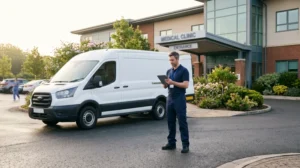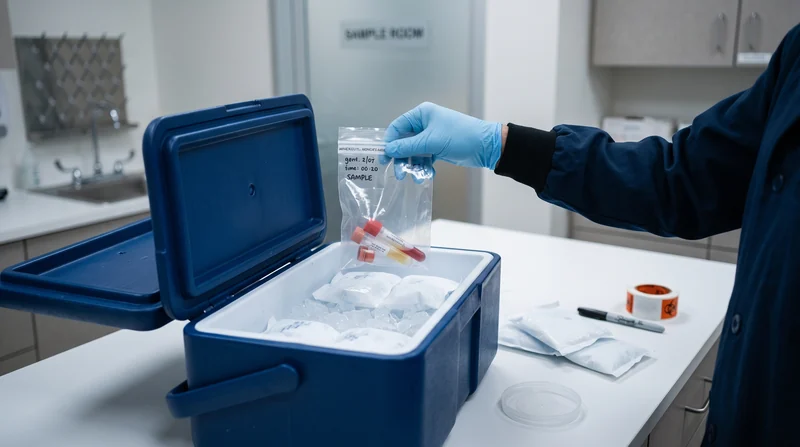
A biological sample courier moves blood, urine, swabs, tissue and other patient specimens from the place they’re collected to the lab that tests them, inside packaging that meets transport rules and within the time and temperature limits the test allows. Most routine clinic specimens travel as UN3373 Category B or as exempt specimens, in triple packaging, by ground.
Problems usually start small: a tube with one identifier, a loose cap, a cooler left in a warm car. This guide covers classification, packaging and marking, temperature windows, chain of custody, and what changes when a specimen flies instead of riding in a van.
The rules below come from federal regulations and IATA and WHO guidance. Your lab’s instructions and your dangerous goods program still have the final word on how a given specimen ships.
Power House Courier runs HIPAA-compliant, UN3373-certified specimen and medical deliveries 24/7 across California, Arizona and Texas. A dispatcher answers in under 15 minutes.
TL;DR
- Specimens fall into Category A (UN2814 or UN2900), Category B (UN3373) or exempt, and the shipper makes that call based on what the specimen is and why it’s being tested.
- Category B specimens go in triple packaging: a leakproof primary receptacle, a leakproof secondary packaging with enough absorbent for liquids, and a rigid outer packaging.
- The completed Category B package must survive a 1.2 meter drop, and for air transport the primary or secondary packaging must withstand a 95 kPa pressure differential.
- Labcorp defines refrigerated as 1.0 to 10.0°C and asks that serum be separated from cells within two hours of venipuncture.
- Every hand-off should be logged with time, name and specimen count so a missing or warm sample can be traced.
Category A, Category B or exempt
Classification decides the packaging, the marks on the box and the paperwork. Federal hazmat rules in 49 CFR 173.134 set the definitions.
Category A is an infectious substance in a form capable of causing permanent disability or life-threatening or fatal disease in otherwise healthy people or animals when exposure occurs. It’s assigned to UN2814 (affecting humans), UN2900 (affecting animals only) or UN3549 for certain medical solid waste. Very few routine clinic specimens fall here.
Category B covers infectious substances that don’t meet the Category A definition. They ship as UN3373, “Biological substance, Category B.” A swab sent for influenza PCR or a blood sample sent for infectious disease testing usually falls here.
Exempt specimens are patient samples with a minimal likelihood that pathogens are present. The WHO’s 2025-2026 transport guidance gives examples such as blood or urine tested for cholesterol, glucose or drugs, where infection isn’t suspected. It says this takes professional judgment, and a shipper who can’t reasonably conclude the risk is minimal must classify the material as Category B.
| Classification | UN number | Typical clinic example | Packaging |
|---|---|---|---|
| Category A | UN2814, UN2900 (or UN3549 for certain waste) | Cultures of high-consequence pathogens | UN-specification packaging, shipping papers, trained shipper |
| Category B | UN3373 | Swabs or blood for infectious disease testing | Triple packaging to 49 CFR 173.199 or IATA PI 650 |
| Exempt human specimen | None | Cholesterol, glucose, hormone or drug testing | Basic triple packaging, marked “Exempt human specimen” |
Triple packaging for UN3373 specimens
Category B packaging is set out in 49 CFR 173.199 for U.S. transport and in IATA Packing Instruction 650 for air. The two line up closely.
The primary receptacle is the tube, cup or vial that holds the specimen. It has to be leakproof for liquids or siftproof for solids.
The secondary packaging is a leakproof bag or canister around the primary. If there are several fragile tubes inside, PI 650 says they must be wrapped or separated so they can’t touch. For liquids, absorbent material goes between the primary and secondary, in enough quantity to soak up the entire contents of the primary receptacles.
The outer packaging is rigid, and at least one surface has to measure at least 100 mm by 100 mm. PI 650 also requires an itemized list of contents between the secondary and outer packaging.
Two performance tests apply. The completed package must withstand a 1.2 meter drop without the primary leaking. And for air, the primary receptacle or secondary packaging must hold an internal pressure differential of at least 95 kPa without leaking.
For air shipments, PI 650 caps each primary receptacle at 1 liter and the outer packaging at 4 liters for liquids or 4 kg for solids, not counting ice or dry ice used for cooling. The WHO guidance notes that surface transport has no per-package quantity limit.
Exempt specimens still need a basic triple package. The WHO guidance says exempt human specimens must travel in a basic triple packaging system with the outermost layer marked “Exempt human specimen.”
Marking and labeling the outer box
A UN3373 package carries a diamond-shaped mark with “UN3373” inside. 49 CFR 173.199 requires each side of the diamond to be at least 50 mm, and PI 650 adds that the line must be at least 2 mm wide and the characters at least 6 mm high. The words “Biological substance, Category B” go next to the diamond.
PI 650 also requires the shipper and consignee names and addresses on each package, and the name and phone number of a responsible person on the air waybill or package. Put the same contact details on ground shipments too.
At the tube level, OSHA’s bloodborne pathogens standard (29 CFR 1910.1030) requires specimens of blood or other potentially infectious materials to go in a container that prevents leakage during transport, labeled or color-coded as biohazard. If the outside of a tube is contaminated, it goes inside a second leak-preventing container.
For identification, Labcorp’s specimen collection guidance says every primary container must be labeled with at least two identifiers at the time of collection, such as patient name and date of birth. A room number doesn’t count.
Temperature ranges and stability windows
Packaging keeps a specimen contained. Temperature and time decide whether it can still be tested.
Labcorp defines room temperature as 10.1 to 40.0°C, refrigerated as 1.0 to 10.0°C, and frozen as -1.0 to -80.0°C. Other labs use slightly different bands, so match the receiving lab’s definitions.
Stability varies by test, so the lab’s test directory beats any general rule. Some published examples:
- Labcorp asks that serum be separated from red cells within two hours of venipuncture.
- Labcorp’s RSV immunoassay listing says to refrigerate for up to 72 hours or freeze if held longer.
- CDC’s influenza specimen collection guide says to keep specimens at 2 to 8°C before shipping and freeze at -70°C if delivery will be delayed more than 3 to 4 days.
- WHO’s RSV specimen guidance says repeated freezing and thawing must be avoided.
Frozen specimens often ride on dry ice. Under PI 650, dry ice goes outside the secondary packaging, with supports that hold the secondary in place as the ice sublimates, and the package has to vent carbon dioxide gas. Dry ice is also a Class 9 hazardous material in its own right. Our temperature-controlled courier page explains how refrigerated and frozen runs are typically handled.
Chain of custody from clinic to lab
Chain of custody is the record of who had the specimen, when, and in what condition. For drug testing it’s a formal legal document. For routine clinical work it’s less formal, but it’s how you find a sample that goes missing.
A workable record captures the bag count at pickup, the time and who handed over, the driver’s name, the temperature state at pickup if the shipment is refrigerated or frozen, and a signed or scanned receipt at the lab with the time and count. If a temperature logger travels with the cooler, its data should be tied to the same delivery record.
Keep patient information out of the courier’s record; bag counts and addresses are enough. Our post on temperature logs, HIPAA and chain of custody goes further into what each document should contain.
Ground courier versus air carrier
Most clinic-to-lab specimens never leave the road, and ground is more forgiving. The 95 kPa requirement is written for air. The WHO guidance notes that for surface transport, either the secondary or the outer packaging must be rigid, while air always requires a rigid outer.
There’s also a narrow federal exception worth knowing about. 49 CFR 173.134(b)(10) excepts non-Category A patient samples carried by a private or contract carrier in a motor vehicle used exclusively to transport such materials. A courier carrying other freight in the same vehicle may not meet the “exclusively” condition, and OSHA’s container rules for blood specimens apply either way. Take it to your dangerous goods program before relying on it.
Air shipments add more. The package must meet PI 650 quantity limits, the airline or integrator’s acceptance rules apply, and if an air waybill is used, it must show “UN 3373” and “BIOLOGICAL SUBSTANCE, CATEGORY B.” Transit time is also less predictable, so stability windows get tighter.
What to hand the courier, and where things go wrong
At pickup, the driver should receive closed, marked outer packages, a count that matches the manifest, and clear instructions on temperature state and destination. If anything must stay frozen, say so when you book.
The rejection criteria labs publish point to the usual failures. Labcorp’s RSV test listing, for example, rejects specimens that arrive in a grossly leaking container, are unlabeled, or arrive after a prolonged delay, usually more than 72 hours. Many of those problems start before the courier arrives: caps not tightened, a single identifier on a tube, specimens left at room temperature waiting for a late pickup, or refrigerated and frozen items packed in the same cooler.
Timing is the other gap. A pickup after the lab’s receiving cutoff can leave a specimen sitting overnight.
Choosing a biological sample courier
Ask any biological sample courier how its drivers are trained for UN3373 and exempt specimens, what they do when a package is damaged or leaking at pickup, and how they keep refrigerated and frozen loads separate. Ask to see a sample delivery record.
Build pickup times backward from your lab’s processing cutoffs, and ask whether urgent runs can be added on the same account. Our medical courier page covers specimen and biological material transport, and the lab courier companies guide compares the kinds of providers labs work with.
Keep your lab in the loop on packaging, accepted temperature ranges and how to report late or damaged specimens.
Related guides: blood components have their own temperature limits, covered in our guide to blood courier services. If you ship specimens by air, check what changes in the 2027 IATA dangerous goods rules, and see our flu season pickup plan for handling respiratory swabs in winter.
Frequently asked questions
Does a courier decide whether a specimen is Category B or exempt?
No. The shipper, meaning the clinic or lab sending the specimen, classifies it based on what it is and what it’s being tested for. WHO guidance says exempt status rests on professional judgment and must be justifiable. A courier should refuse a package that’s obviously marked wrong, but it shouldn’t make the call for you.
What is the difference between UN3373 and UN2814?
UN3373 is “Biological substance, Category B,” used for infectious substances that don’t meet the Category A definition, which covers most diagnostic specimens. UN2814 is Category A affecting humans, for substances capable of causing permanent disability or life-threatening disease when exposure occurs. Category A needs UN-specification packaging and shipping papers, and not every courier is set up to carry it, so ask before booking.
Is the 95 kPa pressure test required for ground delivery?
The 95 kPa requirement in 49 CFR 173.199 and IATA PI 650 is tied to air transport, where pressure changes can force liquid out of a tube. Using 95 kPa-rated bags for everything means the same packaging works whether a box ends up on a van or a plane. Check with your lab before switching supplies.
How long can a blood sample wait before it reaches the lab?
It depends on the test. Labcorp asks that serum be separated from cells within two hours of venipuncture, while some refrigerated specimens are stable for 72 hours or longer. Your reference lab’s test directory lists stability for each test, and your pickup schedule should be built around the shortest window you routinely send.
Can refrigerated and frozen specimens travel in the same cooler?
They shouldn’t. Dry ice can freeze refrigerated tubes, and refrigerated packs can let frozen samples warm. Keep them in separate, labeled containers and tell the courier which is which. PI 650 also requires dry ice to sit outside the secondary packaging, with the outer package able to vent gas.
What paperwork should travel with a UN3373 package?
PI 650 calls for an itemized list of contents between the secondary and outer packaging, plus shipper and consignee details and a responsible person’s phone number. A Shipper’s Declaration for Dangerous Goods isn’t required for UN3373. Your lab may also expect test requisitions and a manifest or pickup log that the courier signs.
Power House Courier runs HIPAA-compliant, UN3373-certified specimen and medical deliveries 24/7 across California, Arizona and Texas. A dispatcher answers in under 15 minutes.
Sources
- 49 CFR 173.134, Class 6, Division 6.2 definitions and exceptions, 2025 edition (govinfo.gov)
- 49 CFR 173.199, Category B infectious substances, 2025 edition (govinfo.gov)
- IATA Dangerous Goods Regulations, 67th Edition (2026), Packing Instruction 650
- WHO: Guidance on regulations for the transport of infectious substances 2025-2026
- 29 CFR 1910.1030, Bloodborne pathogens (Cornell LII)
- Labcorp: Introduction to Specimen Collection
- Labcorp: Respiratory Syncytial Virus (RSV), Immunoassay (014548)
- CDC: Influenza Specimen Collection reference guide
- WHO: RSV surveillance, collection, transport and storage of clinical specimens
Need specimens moved between a clinic and a lab? Call dispatch at (323) 744-1900 or request a quote.
Last reviewed: September 2026 by the Power House Courier dispatch team.

Critical logistics across the USA — same day courier, medical, legal, AoG, and nationwide trucking. Available 24/7.